Handshakes — valid-ready & req-ack
Handshakes are how RTL blocks agree that a transfer happened. Valid-ready (AXI-stream style) and req-ack (classic bus) are the two you'll see everywhere. Get the rules wrong and you get dropped data, deadlock, or combinational loops that synthesis rejects.
Valid-ready: valid && ready on a clock edge (or combo handshake).
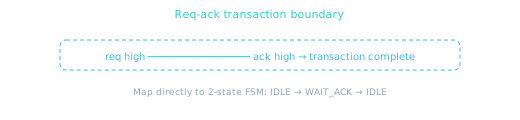
Req-ack: req asserted, ack returned — timing defined by protocol (level vs pulse).
Handshakes are the contract between RTL blocks. AXI-Stream, TileLink, and internal FIFO interfaces all boil down to valid-ready or req-ack semantics. Violating independence rules creates combinational loops that synthesis rejects and simulation may hide until silicon.
Valid-ready — the four rules
| Rule | Sender (valid) | Receiver (ready) |
|---|---|---|
| 1 | valid may rise anytime | ready may rise anytime |
| 2 | Once valid high, data must stay stable until transfer | Once ready high, receiver must accept if valid |
| 3 | Transfer = valid && ready | Same |
| 4 | Sender drops valid after transfer (unless back-to-back) | Receiver may deassert ready after transfer |
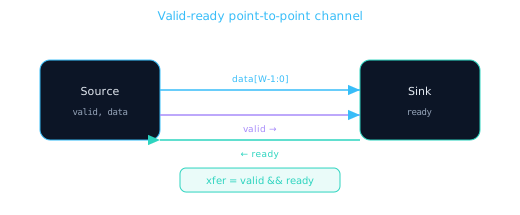
Transfer occurs when valid && ready are both high.
Valid-ready RTL — sender & receiver
// Sender: assert valid when data available; hold until xfer
always @(posedge clk or negedge rst_n) begin
  if (!rst_n) begin
    valid <= 1'b0;
    data  <= 8'h00;
  end else if (valid && ready) begin
    valid <= 1'b0;           // transfer complete
    // load next beat if available
  end else if (!valid && has_data) begin
    valid <= 1'b1;
    data  <= next_data;
  end
  // else: hold valid and data (rule 2)
end
// Receiver: ready when internal buffer has space
assign ready = !fifo_full;   // ★ ready NOT a function of valid!

// Capture on transfer
always @(posedge clk) begin
  if (valid && ready)
    fifo_push(data);
end
NEVER: assign ready = !valid; or assign valid = ready; — this creates a combinational loop. ready must depend only on receiver internal state (FIFO space). valid only on sender state.
Back-to-back transfers — sustained throughput
When both sides are ready, valid-ready supports one transfer per cycle without gaps. The sender keeps valid high and updates data each cycle while ready stays high.
AXI-Stream alignment: This is exactly AXI-Stream beat behavior — TVALID/TREADY with no mandatory gap between beats. Req-ack level protocols usually need an IDLE cycle between transactions.
Deadlock — when handshakes never complete
Deadlock happens when both sides wait on each other: sender won't assert valid until ready, receiver won't assert ready until valid. Classic combo-loop variant at the protocol level.
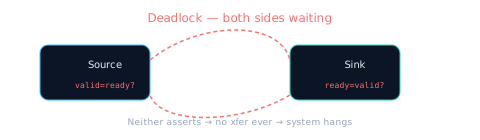
Always-ready sink (assign ready = 1) is fine for testbenches. In real designs, ready must reflect back-pressure. Never tie ready to valid — even indirectly through a long combo chain.
Skid buffer — break the ready timing path
When the receiver's ready logic is slow, a skid buffer (2-entry FIFO) lets the sender see ready=1 one cycle earlier. Full design in Module 7.1 — here's the concept:
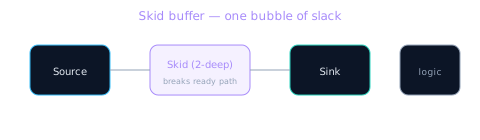
Without skid: ready = f(slow_logic) → long combo path. With skid: ready = !skid_full (fast). The skid absorbs one cycle when sink hiccups.
Req-ack — level-sensitive handshake
| Signal | Direction | Meaning |
|---|---|---|
req | Requester → Servicer | "I need a transfer / service" |
ack | Servicer → Requester | "Transfer accepted / done" |
// Requester FSM — level req until ack
localparam IDLE = 2'd0, WAIT = 2'd1;
reg [1:0] state;

always @(posedge clk or negedge rst_n) begin
  if (!rst_n) begin
    state <= IDLE;
    req   <= 1'b0;
  end else case (state)
    IDLE: if (want_xfer) begin
            req   <= 1'b1;
            state <= WAIT;
          end
    WAIT: if (ack) begin
            req   <= 1'b0;
            state <= IDLE;
          end
    default: state <= IDLE;
  endcase
end
Valid-ready vs req-ack — when to use
| Protocol | Strength | Common in |
|---|---|---|
| Valid-ready | Back-pressure native; pipelined; burst-friendly | AXI-Stream, TileLink, internal NoC |
| Req-ack | Simple FSM mapping; clear transaction boundary | Register bus, config ports, legacy IPs |
Handshake design checklist
- Transfer condition documented:
valid&readyorreq&ack readynever depends combinationally onvalid- Sender holds
datastable whilevalidasserted (until xfer) - No combinational loops through handshake signals
- FSM has safe default; req dropped only after ack
- Back-pressure path tested: sink never ready for N cycles
- Consider skid buffer if ready path is on critical timing
🎯 What to remember
- Valid-ready transfer =
valid && ready— both sides independent. - Never tie
readytovalid— combo loop trap. - Req-ack maps cleanly to 2-state FSMs — great for simple ports.
- Skid buffers break ready timing — Module 7.1 goes deep.