Assertions (SVA lite) for RTL owners
Assertions are executable spec comments — they watch your design 24/7 during simulation and scream the moment an invariant breaks. RTL owners don't need full formal verification fluency; a handful of immediate and concurrent SVA patterns cover 80% of real blocks.
An assertion states a property that must always hold (or hold after a trigger). assert(condition) is the immediate form. assert property (@(posedge clk) ...) is the concurrent form — it monitors signals across clock cycles.
Two flavors — immediate vs concurrent
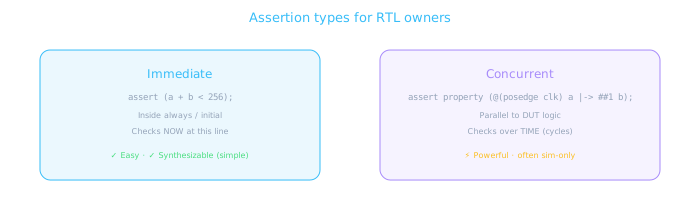
Start with immediate asserts in your RTL. Add concurrent properties for protocol timing you can't express in one line.
| Type | Syntax | When to use | Synth? |
|---|---|---|---|
| Immediate | assert (expr) else $error(...) | One-cycle invariants inside always | Often yes |
| Concurrent | assert property (p) else $error(...) | Multi-cycle protocol rules | Depends on tool |
| Assume | assume property (p) | Constrain inputs (formal/sim) | Sim / formal |
| Cover | cover property (p) | Did this scenario ever happen? | Sim only |
Immediate asserts — RTL owners write these
Drop these inside your always blocks or at the end of a combinational block. They catch logic bugs during simulation and can sometimes synthesize into hardware checkers.
// Inside an always @(posedge clk) block:
always @(posedge clk) begin
  if (en && !full)
    wr_ptr <= wr_ptr + 1;

  // One-hot FSM check (sim + some synth flows)
  assert ($onehot(state))
    else $error("FSM state not one-hot: %b", state);

  // Mutually exclusive controls
  assert (!(wr_en && rd_en && empty))
    else $error("Read and write when empty");
end

// Combinational range check
always @(*) begin
  assert (addr < DEPTH)
    else $error("Address out of range: %0d", addr);
end
Don't assert on signals that are X during reset unless you guard with if (rst_n). Unconditional asserts during reset cause false failures and teach you to ignore assertion noise.
Concurrent SVA lite — the essentials
Concurrent assertions use properties — temporal expressions evaluated every clock edge. Three operators cover most RTL owner needs:
|->(overlapping implication): if antecedent is true now, consequent must hold.##N(delay): wait N clock cycles.$rose(sig)/$fell(sig): detect edges.
// Valid-ready handshake: transfer only when both high
property p_xfer;
  @(posedge clk) disable iff (!rst_n)
    (s_valid && s_ready) |-> ##1 (data_captured);
endproperty
assert property (p_xfer) else $error("Transfer handshake violated");

// After reset release, FSM must reach IDLE within 3 cycles
property p_reset_to_idle;
  @(posedge clk) $rose(rst_n) |-> ##[1:3] (state == IDLE);
endproperty
assert property (p_reset_to_idle)
  else $error("FSM did not return to IDLE after reset");

// m_valid must stay high until m_ready
property p_valid_hold;
  @(posedge clk) disable iff (!rst_n)
    (m_valid && !m_ready) |=> m_valid;  // |=> non-overlapping next cycle
endproperty
assert property (p_valid_hold)
  else $error("m_valid dropped before handshake");
p_xfer checks data captured at cycle 3
p_valid_hold checks m_valid stays 1 after cycle 3
SVA operator cheat sheet
| Operator | Meaning | Example |
|---|---|---|
|-> | If A now, then B (same cycle start) | a |-> b |
|=> | If A now, then B next cycle | a |=> b |
##1 | Delay exactly 1 cycle | a |-> ##1 b |
##[1:5] | Delay 1 to 5 cycles | a |-> ##[1:5] b |
$rose(x) | x went 0→1 this cycle | $rose(req) |
$fell(x) | x went 1→0 this cycle | $fell(ack) |
disable iff | Skip check when condition true | disable iff (!rst_n) |
Synthesizable vs simulation-only
Synthesizable
Simple immediate asserts, one-hot checks, range checks. Some flows map these to hardware error flags.
Sim-only
Complex ##[m:n] ranges, cover property, sequences with repetition. Keep in ifdef SIM or bind file.
Bind file pattern
Put sim-only assertions in a separate *_assert.sv bound to DUT — keeps RTL clean for synthesis.
// assertions bind file — not synthesized
`ifdef SIM
bind sync_fifo fifo_assertions #(
  .DEPTH(DEPTH)
) u_assert (
  .clk   (clk),
  .rst_n (rst_n),
  .wr_en (wr_en),
  .rd_en (rd_en),
  .full  (full),
  .empty (empty),
  .count (count)
);

module fifo_assertions #(parameter DEPTH=16) (
  input clk, rst_n, wr_en, rd_en, full, empty,
  input [$clog2(DEPTH+1)-1:0] count
);
  assert property (@(posedge clk) disable iff (!rst_n)
    full |-> !wr_en)
    else $error("Write when full!");

  assert property (@(posedge clk) disable iff (!rst_n)
    empty |-> !rd_en)
    else $error("Read when empty!");
endmodule
`endif
FSM assertion example — RTL owner pattern
FSMs are the #1 place RTL owners add assertions. Encode legal transitions directly from your state diagram:
// States: IDLE=0, BUSY=1, DONE=2
localparam IDLE=0, BUSY=1, DONE=2;

// Only legal transitions (from state diagram)
property p_idle_to_busy;
  @(posedge clk) disable iff (!rst_n)
    (state == IDLE && start) |-> ##1 (state == BUSY);
endproperty

property p_busy_to_done;
  @(posedge clk) disable iff (!rst_n)
    (state == BUSY && done_flag) |-> ##1 (state == DONE);
endproperty

property p_done_to_idle;
  @(posedge clk) disable iff (!rst_n)
    (state == DONE && ack) |-> ##1 (state == IDLE);
endproperty

assert property (p_idle_to_busy)  else $error("Illegal: IDLE->? (not BUSY)");
assert property (p_busy_to_done)  else $error("Illegal: BUSY->? (not DONE)");
assert property (p_done_to_idle)  else $error("Illegal: DONE->? (not IDLE)");

// Cover: did we ever reach DONE? (functional coverage tie-in)
cover property (@(posedge clk) (state == DONE));
What RTL owners should assert
- Handshake invariants: valid held until ready; no transfer when not ready.
- FSM legality: one-hot encoding; only legal transitions occur.
- Pointer safety: no read when empty, no write when full.
- Reset behavior: outputs deassert within N cycles of reset release.
- X prevention: critical outputs never X after reset (where tool supports).
Rule of thumb: if you wrote it in the spec as "must never" or "shall always", it belongs in an assertion. If you wrote it as "output equals X when Y", it belongs in the testbench checker.
Assertion checklist
- Immediate asserts for one-cycle invariants inside RTL or bind file
- All asserts guarded with
disable iff (!rst_n)or equivalent - Concurrent properties for multi-cycle protocol rules (valid-ready, req-ack)
- Sim-only assertions wrapped in
`ifdef SIMor placed in bind files - Every assertion has a descriptive
$errormessage with signal values - Assertions reviewed against spec — not copy-pasted from TB checks
🎯 What to remember
- Immediate asserts = "right now" checks. Concurrent = "over time" checks.
|->,##N,$rosecover most RTL-owner protocol needs.- Guard assertions during reset; unguarded asserts create noise.
- Keep sim-only SVA in bind files — synthesis stays clean.