Directed tests → corner cases
Happy-path tests prove your design works when everything goes right. Corner-case tests prove it survives when things go wrong — reset mid-transfer, backpressure, overflow, and illegal inputs. Bugs live at the edges.
A directed test is a hand-crafted scenario: you choose exact inputs, timing, and expected outputs. Start with the nominal path, then systematically attack each boundary condition listed in your test plan.
Happy path vs corner cases
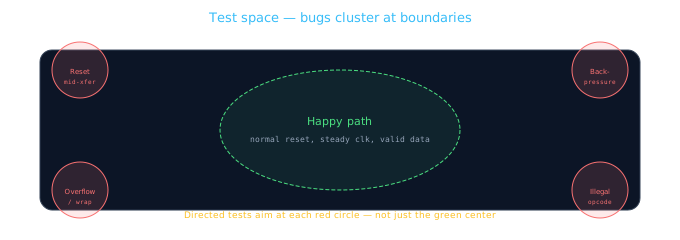
Most designers test the green zone first. Production bugs come from the red boundary conditions.
Test plan table — our example DUT
We'll verify a small valid-ready ALU (same family as Module 8 lab). The test plan maps every scenario to stimulus, expected result, and priority.
| ID | Scenario | Stimulus | Expected | Priority |
|---|---|---|---|---|
| T01 | Happy path ADD | s_valid=1, a=10, b=20, op=ADD | result=30, m_valid=1 | P0 |
| T02 | Happy path MUL | a=6, b=7, op=MUL | result=42 | P0 |
| T03 | Reset mid-transfer | Assert s_valid, drop rst_n before result | No spurious m_valid; clean after reset | P1 |
| T04 | Backpressure | Hold m_ready=0 for N cycles | m_valid stays high; result stable | P1 |
| T05 | Overflow / max values | a=16'hFFFF, b=1, op=ADD | result=0 (wrap) | P1 |
| T06 | Illegal opcode | op=2'b11 (reserved) | result=0 or error flag per spec | P2 |
| T07 | s_valid without s_ready | Drive valid when full | Data not accepted; no corruption | P1 |
Test plan discipline: write the table before coding tests. Review it with your spec. If a row has no expected column, the spec is incomplete.
Corner case: reset mid-transfer
Start a transaction, then yank reset before the result appears. The DUT must return to idle with no phantom outputs.
// T03 — reset arrives while operation is in flight
task test_reset_mid_xfer;
  begin
    @(posedge clk);
    s_valid = 1; a = 16'd100; b = 16'd50; op = 2'b00;
    @(posedge clk);  // accepted into pipe

    // Reset BEFORE result emerges
    rst_n = 0;
    repeat (2) @(posedge clk);
    rst_n = 1;
    repeat (3) @(posedge clk);

    // After reset: no valid output, no stale data
    if (m_valid !== 1'b0) begin
      $display("FAIL T03: m_valid should be 0 after reset");
      errors = errors + 1;
    end else
      $display("PASS T03: clean idle after reset mid-xfer");
  end
endtask
After reset mid-transfer, don't just check m_valid — also verify internal state (FSM state, counters) if you have hierarchical access. A quiet output with a dirty FSM will fail on the next transaction.
Corner case: backpressure
When downstream isn't ready (m_ready=0), the DUT must hold the result without dropping or duplicating it.
// T04 — hold m_ready low; result must not change
task test_backpressure;
  reg [31:0] captured;
  begin
    drive_op(16'd7, 16'd3, 2'b00);  // ADD → 10
    wait(m_valid);
    captured = result;
    m_ready = 0;

    repeat (5) @(posedge clk);
    if (result !== captured) begin
      $display("FAIL T04: result changed under backpressure");
      errors = errors + 1;
    end
    if (m_valid !== 1'b1) begin
      $display("FAIL T04: m_valid dropped while stalled");
      errors = errors + 1;
    end

    m_ready = 1;
    @(posedge clk);
    if (result !== 32'd10) begin
      $display("FAIL T04: wrong result after release");
      errors = errors + 1;
    end else
      $display("PASS T04: backpressure held correctly");
  end
endtask
Corner cases: overflow & illegal opcode
// T05 — 16-bit overflow wrap
task test_overflow;
  begin
    drive_op(16'hFFFF, 16'd1, 2'b00);
    check_result(32'd0, "T05_overflow_wrap");
  end
endtask

// T06 — illegal opcode (must match YOUR spec)
task test_illegal_opcode;
  begin
    drive_op(16'd5, 16'd5, 2'b11);  // reserved op
    wait(m_valid);
    @(posedge clk);
    // Spec says: default → 0. Adjust if your spec differs!
    if (result !== 32'd0) begin
      $display("FAIL T06: illegal op returned %0d", result);
      errors = errors + 1;
    end else
      $display("PASS T06: illegal opcode handled");
  end
endtask
Boundary values
Test 0, 1, MAX, MAX-1, MAX+1. Overflow bugs hide at bit-width edges.
Illegal inputs
Reserved opcodes, out-of-range addresses — define expected behavior in spec, then test it.
Back-to-back stress
After each corner, run a happy-path test to confirm recovery.
Test suite runner — tying it together
initial begin
  errors = 0;
  rst_n = 0; m_ready = 1; s_valid = 0;
  repeat (3) @(posedge clk);
  rst_n = 1;

  $display("=== P0: Happy path ===");
  drive_op(16'd10, 16'd20, 2'b00);
  check_result(32'd30, "T01_add");
  drive_op(16'd6, 16'd7, 2'b01);
  check_result(32'd42, "T02_mul");

  $display("=== P1: Corner cases ===");
  test_reset_mid_xfer();
  test_backpressure();
  test_overflow();

  $display("=== P2: Edge / illegal ===");
  test_illegal_opcode();

  $display("===================================");
  if (errors == 0) $display("=== ALL DIRECTED TESTS PASSED ===");
  else             $display("=== %0d CORNER TEST(S) FAILED ===", errors);
  $finish;
end
Reusable TB tasks — drive and check
Corner-case tests share the same drive/check infrastructure. Factor these into tasks once:
task drive_op(input [15:0] ta, tb; input [1:0] top);
  begin
    @(posedge clk);
    s_valid = 1; a = ta; b = tb; op = top;
    wait(s_ready);
    @(posedge clk);
    s_valid = 0;
  end
endtask

task check_result(input [31:0] exp; input string name);
  begin
    wait(m_valid);
    @(posedge clk);
    #1;
    if (result !== exp) begin
      $display("FAIL [%s]: got %0d expected %0d at t=%0t",
               name, result, exp, $time);
      errors = errors + 1;
    end else
      $display("PASS [%s]", name);
  end
endtask

// Every corner test calls these — consistent timing, consistent errors
How to find corners you missed
- Spec walk: every "shall", "if", "when" in the spec → at least one test row.
- Interface signals: toggle each handshake signal independently (valid without ready, ready without valid).
- State coverage: visit every FSM state; enter/exit each via at least two paths.
- Peer review: ask a colleague "what would break this?" — they'll name a corner you missed.
Directed test checklist
- Test plan table written with ID, stimulus, expected, priority
- P0 happy-path tests pass before attacking corners
- Reset mid-operation tested for every block with internal state
- Backpressure / flow control tested on every valid-ready interface
- Overflow and boundary values tested at bit-width limits
- Illegal / reserved inputs have defined expected behavior
- Recovery test (happy path) runs after each destructive corner
🎯 What to remember
- Happy path proves it works; corner cases prove it doesn't break.
- Write a test plan table — bugs hide in rows you never wrote.
- Reset mid-xfer, backpressure, overflow, illegal opcode: the big four for most blocks.
- Always verify recovery — a corner test that leaves dirty state is incomplete.