Async FIFO overview — Gray pointers
When writer and reader live on different clocks, a sync FIFO's shared pointers break. The async FIFO is the standard bridge — and its secret weapon is Gray-coded pointers crossed through synchronizers. This lesson is the overview; the CDC course covers the deep dive.
An async FIFO stores data in a dual-port RAM. Write logic runs on wr_clk; read logic on rd_clk. Pointers cross domains as Gray codes through 2+ flop synchronizers so full/empty flags are safe (conservative).
Why you need an async FIFO
Real chips have multiple clock domains: CPU core, DDR controller, PCIe PHY, sensor interface. You cannot share a sync FIFO pointer across unrelated clocks — metastability and multi-bit coherency destroy count and compare logic.
Clock domain crossing
Producer and consumer operate asynchronously. Data must be buffered safely between domains.
Rate matching
Burst writer (e.g. DMA) vs steady reader (processor). FIFO absorbs bursts without dropping beats.
Metastability shield
Only control pointers cross — data stays in RAM written on wr_clk, read on rd_clk.
Two people on different schedules pass notes through a locked mailbox. Each has their own key (clock). They never reach in at the same time — they only check a flag ("mail waiting") that the other side updates safely with a delay.
Architecture — dual clock, Gray crossing
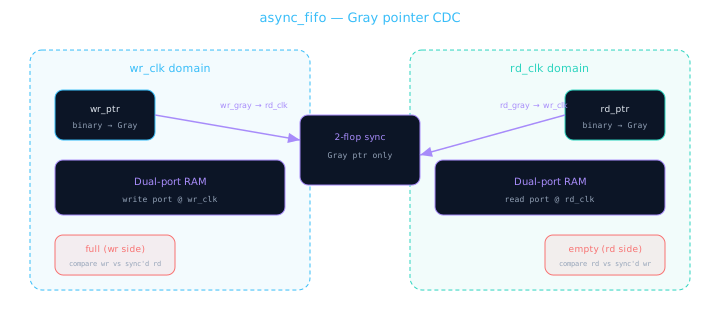
Each side computes full/empty using its local pointer and the synchronized remote pointer. Data never crosses — only Gray pointers do.
Binary vs Gray — why Gray wins at CDC
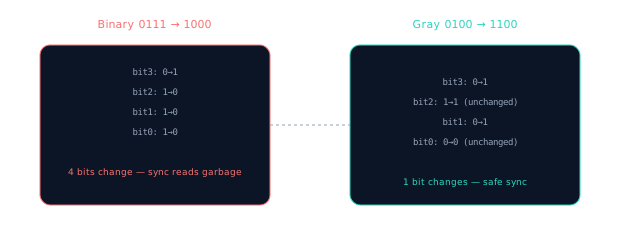
At count 7→8, binary flips 4 bits. Gray flips exactly 1 bit. A 2-flop synchronizer on Gray may sample old or new value — never an impossible state.
| Count | Binary | Gray | Bits changed |
|---|---|---|---|
| 0 | 000 | 000 | — |
| 1 | 001 | 001 | 1 |
| 2 | 010 | 011 | 1 |
| 3 | 011 | 010 | 1 |
| 4 | 100 | 110 | 1 |
| 5 | 101 | 111 | 1 |
| 6 | 110 | 101 | 1 |
| 7 | 111 | 100 | 1 |
Gray pointer conversion RTL
// Binary ↔ Gray for async FIFO pointers
function automatic [PTR_W:0] bin2gray(input [PTR_W:0] bin);
  bin2gray = bin ^ (bin >> 1);
endfunction

function automatic [PTR_W:0] gray2bin(input [PTR_W:0] gray);
  integer i;
  gray2bin[PTR_W] = gray[PTR_W];
  for (i = PTR_W-1; i >= 0; i = i - 1)
    gray2bin[i] = gray2bin[i+1] ^ gray[i];
endfunction

// Cross wr_gray to rd_clk domain (2-flop synchronizer)
reg [PTR_W:0] rd_sync_wr_gray_q1, rd_sync_wr_gray_q2;
always @(posedge rd_clk or negedge rd_rst_n) begin
  if (!rd_rst_n) begin
    rd_sync_wr_gray_q1 <= {(PTR_W+1){1'b0}};
    rd_sync_wr_gray_q2 <= {(PTR_W+1){1'b0}};
  end else begin
    rd_sync_wr_gray_q1 <= wr_gray;
    rd_sync_wr_gray_q2 <= rd_sync_wr_gray_q1;
  end
end
Never synchronize a binary multi-bit pointer directly. Never use the synchronized pointer for RAM addressing — only for full/empty comparison. RAM access uses the local binary pointer.
Conservative full/empty
Because synchronized pointers lag reality, flags must be conservative:
- wr-side full: may assert early (thinks FIFO is fuller than reality) → safe: writer pauses sooner, never overflows
- rd-side empty: may assert early (thinks FIFO is emptier than reality) → safe: reader waits longer, never underflows
// Write side: full when wr_gray == {~rd_gray_sync[MSB], rd_gray_sync[MSB-1:0]}
assign wr_full  = (wr_gray == {~rd_gray_sync[PTR_W], rd_gray_sync[PTR_W-1:0]});
// Read side: empty when rd_gray == wr_gray_sync
assign rd_empty = (rd_gray == wr_gray_sync);
Go deeper: Full CDC methodology — metastability MTBF, synchronizer chains, pulse crossing, and formal CDC signoff — is covered in the EcrioniX CDC course. Also see Premium course index for related material.
CDC course topics
2-flop vs 3-flop sync, MTBF calculation, pulse synchronizers, and structural CDC lint rules.
Formal CDC
Tools check for unsynchronized crossings, reconvergence, and glitch-prone paths before tapeout.
Vendor FIFO IP
Xilinx FIFO Generator, Intel SC FIFO — parameterized, timing-closed, use in production flows.
Do / don't checklist
| ✅ Do | ❌ Don't |
|---|---|
| Gray-encode pointers before CDC | Sync binary pointers for full/empty |
| Use 2+ flop synchronizers per Gray bus | Assume synchronized ptr is cycle-accurate |
| Reset both domains independently | Cross async reset without synchronizer |
| Use dual-port RAM (true dual-port or 2R1W) | Read/write same addr same cycle blindly |
| Document conservative flag latency | Build full custom async FIFO without review |
| Use vendor FIFO IP when possible | Cross data buses without handshake/FIFO |
- Verify empty flag on rd_clk — no read when count could be 0
- Verify full flag on wr_clk — no write when count could be DEPTH
- Simulate with different wr_clk and rd_clk frequencies (faster/slower each way)
- Run CDC structural checks if your flow supports them
Simulation strategy for async FIFOs
CDC bugs hide in corner cases. Your testbench should vary clock ratios and phase:
- wr_clk faster: fill FIFO until
wr_full, verify no write corruption - rd_clk faster: drain until
rd_empty, verify no read garbage - Reset sequencing: assert
wr_rstandrd_rstindependently; FIFO must recover empty - Near-simultaneous full/empty: rapid toggle of both enables — flags stay conservative
Typical wr_clk=100MHz, rd_clk=66MHz fill-then-drain pattern:
fill phase → full → drain → empty
// Clock generators — different periods
initial wr_clk = 0; always #5  wr_clk = ~wr_clk;  // 100 MHz
initial rd_clk = 0; always #7.5 rd_clk = ~rd_clk;  // ~67 MHz

task fill_to_full;
  integer i;
  begin
    for (i = 0; i < DEPTH; i = i + 1) begin
      @(posedge wr_clk);
      wr_en = 1; wdata = i[7:0];
    end
    @(posedge wr_clk); wr_en = 0;
    if (!wr_full) $display("FAIL: not full after %0d writes", DEPTH);
  end
endtask
When to build vs buy
"Would you design an async FIFO from scratch?" — For learning and small FPGAs, yes — understand Gray pointers and conservative flags. For production ASICs, use characterized vendor IP or a team-reviewed library cell. Your value is knowing why it works and how to verify it.
🎯 What to remember
- Async FIFO bridges different clocks — data stays in dual-port RAM; pointers cross as Gray codes.
- Gray changes 1 bit per step → synchronizer sees old or new value, never garbage.
- Full/empty flags are conservative due to sync delay — that's a feature, not a bug.
- Deep CDC topics live in the CDC course — this lesson is the RTL designer's map.