Lab: pipelined ALU / multiplier
Build a 3-stage pipelined datapath with valid-ready handshakes: stage 1 latches operands, stage 2 runs a wide multiply partial, stage 3 finishes add/shift and presents the result. Includes global stall and flush for hazard practice.
Produce synthesizable pipe_alu_mul plus self-checking testbench you can paste into the EcrioniX Verilog simulator. This is the Module 8 checkpoint — throughput vs latency made concrete.
Pipeline Hazards & Forwarding Lab
Instruction Queue
Register File
Block diagram — 3-stage pipe
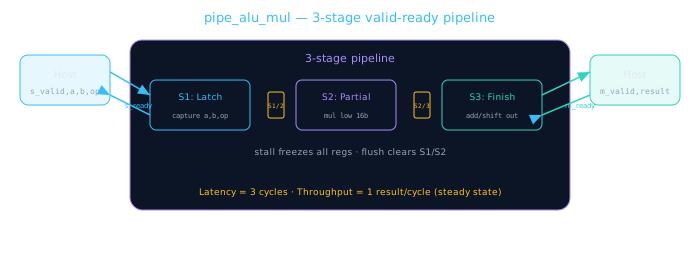
Valid-ready at input and output. Internal stages use enable/stall/flush from lessons 8.3–8.4.
| Stage | Function | Register |
|---|---|---|
| S1 | Latch a, b, op on s_valid&s_ready | s1_reg |
| S2 | Compute partial = (a[15:0] * b[15:0]) | s2_reg |
| S3 | Finish: ADD/MUL/AND per op; drive m_valid | s3_reg (output skid) |
Interface spec
- Input:
s_valid,s_ready,a[15:0],b[15:0],op[1:0](00=ADD, 01=MUL, 10=AND) - Output:
m_valid,m_ready,result[31:0] - Control:
stallfreezes all stage regs;flushclears S1/S2 bubbles - Timing: first result appears 3 cycles after accepted input; then 1/cycle
Steady-state throughput (m_ready=1):
Stage 1 — input latch + back-pressure
// S1: accept operands when downstream not full
wire s1_full = s2_valid && s3_valid && !m_ready; // simple back-pressure
assign s_ready = !s1_full && !flush;

always @(posedge clk or negedge rst_n) begin
  if (!rst_n) begin
    s1_valid <= 1'b0;
    s1_a     <= 16'h0;
    s1_b     <= 16'h0;
    s1_op    <= 2'b00;
  end else if (flush) begin
    s1_valid <= 1'b0;
  end else if (!stall) begin
    if (s_valid && s_ready) begin
      s1_valid <= 1'b1;
      s1_a     <= a;
      s1_b     <= b;
      s1_op    <= op;
    end else if (s2_ready)
      s1_valid <= 1'b0;  // advanced to S2
  end
end
s_ready must reflect downstream capacity — not combo-looped through s_valid. Compute readiness from stage occupancy and m_ready, not from the current beat's data.
Stage 2 & 3 — compute pipeline
// S2: partial multiply — breaks long combo path
wire [31:0] partial_mul = s1_a * s1_b;

always @(posedge clk or negedge rst_n) begin
  if (!rst_n) begin
    s2_valid   <= 1'b0;
    s2_partial <= 32'h0;
    s2_op      <= 2'b00;
    s2_a       <= 16'h0;
    s2_b       <= 16'h0;
  end else if (flush) begin
    s2_valid <= 1'b0;
  end else if (!stall && s1_valid && s2_ready) begin
    s2_valid   <= 1'b1;
    s2_partial <= partial_mul;
    s2_op      <= s1_op;
    s2_a       <= s1_a;
    s2_b       <= s1_b;
  end else if (s3_ready)
    s2_valid <= 1'b0;
end
// S3: final ALU op + output valid-ready
function automatic [31:0] alu_finish (
  input [1:0] op,
  input [31:0] partial,
  input [15:0] a, b
);
  case (op)
    2'b00: alu_finish = {16'h0, a} + {16'h0, b};
    2'b01: alu_finish = partial;
    2'b10: alu_finish = {16'h0, a} & {16'h0, b};
    default: alu_finish = 32'h0;
  endcase
endfunction

wire [31:0] s3_result_w = alu_finish(s2_op, s2_partial, s2_a, s2_b);
assign s2_ready = !s3_valid || m_ready;
assign m_valid  = s3_valid;
assign result   = s3_result;

always @(posedge clk or negedge rst_n) begin
  if (!rst_n) s3_valid <= 1'b0;
  else if (!stall) begin
    if (s2_valid && s2_ready) begin
      s3_valid <= 1'b1;
      s3_result <= s3_result_w;
    end else if (m_ready)
      s3_valid <= 1'b0;
  end
end
Full DUT — paste-ready module
// pipe_alu_mul — Module 8.5 lab DUT
// 3-stage pipelined ALU/multiplier with valid-ready IO
module pipe_alu_mul (
  input  wire        clk,
  input  wire        rst_n,
  input  wire        stall,
  input  wire        flush,
  input  wire        s_valid,
  output wire        s_ready,
  input  wire [15:0] a,
  input  wire [15:0] b,
  input  wire [1:0]  op,
  output wire        m_valid,
  input  wire        m_ready,
  output wire [31:0] result
);
  reg        s1_valid, s2_valid, s3_valid;
  reg [15:0] s1_a, s1_b, s2_a, s2_b;
  reg [1:0]  s1_op, s2_op;
  reg [31:0] s2_partial, s3_result;

  wire s2_ready;
  wire [31:0] partial_mul = s1_a * s1_b;

  assign s_ready = !stall && !flush &&
                   (!s3_valid || m_ready);
  assign s2_ready = !s3_valid || m_ready;
  assign m_valid  = s3_valid;
  assign result   = s3_result;

  function [31:0] finish_op;
    input [1:0] op_in;
    input [31:0] p;
    input [15:0] ai, bi;
    begin
      case (op_in)
        2'b00: finish_op = {16'h0, ai} + {16'h0, bi};
        2'b01: finish_op = p;
        2'b10: finish_op = {16'h0, ai} & {16'h0, bi};
        default: finish_op = 32'h0;
      endcase
    end
  endfunction

  // S1
  always @(posedge clk or negedge rst_n) begin
    if (!rst_n) begin s1_valid <= 0; s1_a <= 0; s1_b <= 0; s1_op <= 0; end
    else if (flush) s1_valid <= 0;
    else if (!stall && s_valid && s_ready) begin
      s1_valid <= 1; s1_a <= a; s1_b <= b; s1_op <= op;
    end else if (s2_ready) s1_valid <= 0;
  end

  // S2
  always @(posedge clk or negedge rst_n) begin
    if (!rst_n) begin s2_valid <= 0; s2_partial <= 0; s2_op <= 0; s2_a <= 0; s2_b <= 0; end
    else if (flush) s2_valid <= 0;
    else if (!stall && s1_valid && s2_ready) begin
      s2_valid <= 1; s2_partial <= partial_mul; s2_op <= s1_op;
      s2_a <= s1_a; s2_b <= s1_b;
    end else if (s3_valid && m_ready) s2_valid <= 0;
  end

  // S3
  always @(posedge clk or negedge rst_n) begin
    if (!rst_n) begin s3_valid <= 0; s3_result <= 0; end
    else if (!stall) begin
      if (s2_valid && s2_ready) begin
        s3_valid <= 1;
        s3_result <= finish_op(s2_op, s2_partial, s2_a, s2_b);
      end else if (m_ready) s3_valid <= 0;
    end
  end
endmodule
Self-checking testbench
module pipe_alu_mul_tb;
  reg clk, rst_n, stall, flush;
  reg s_valid, m_ready;
  reg [15:0] a, b;
  reg [1:0] op;
  wire s_ready, m_valid;
  wire [31:0] result;

  pipe_alu_mul dut (
    .clk(clk), .rst_n(rst_n), .stall(stall), .flush(flush),
    .s_valid(s_valid), .s_ready(s_ready), .a(a), .b(b), .op(op),
    .m_valid(m_valid), .m_ready(m_ready), .result(result)
  );

  initial clk = 0;
  always #5 clk = ~clk;

  integer errors, ops_sent, ops_rcvd;
  reg [31:0] expect;

  task drive_op(input [15:0] ta, tb; input [1:0] top);
    begin
      @(posedge clk); s_valid = 1; a = ta; b = tb; op = top;
      wait(s_ready); @(posedge clk); s_valid = 0;
      ops_sent = ops_sent + 1;
    end
  endtask

  task check_result(input [31:0] exp);
    begin
      wait(m_valid); @(posedge clk);
      if (result !== exp) begin
        $display("FAIL: got %0d expected %0d", result, exp);
        errors = errors + 1;
      end else begin
        $display("PASS: result %0d", result);
        ops_rcvd = ops_rcvd + 1;
      end
    end
  endtask

  initial begin
    errors = 0; ops_sent = 0; ops_rcvd = 0;
    rst_n = 0; stall = 0; flush = 0; s_valid = 0; m_ready = 1;
    #20 rst_n = 1;

    // Test 1: ADD 10 + 20 = 30 (3-cycle latency)
    drive_op(16'd10, 16'd20, 2'b00);
    #5; // still in pipe
    check_result(32'd30);

    // Test 2: MUL 100 * 200 = 20000
    drive_op(16'd100, 16'd200, 2'b01);
    check_result(32'd20000);

    // Test 3: back-pressure — hold m_ready low
    m_ready = 0;
    drive_op(16'd5, 16'd7, 2'b00);
    repeat(4) @(posedge clk);
    if (!m_valid) begin $display("FAIL: m_valid should be high"); errors++; end
    m_ready = 1;
    @(posedge clk);
    check_result(32'd12);

    // Test 4: burst throughput — 4 ops back-to-back
    m_ready = 1;
    drive_op(16'd1, 16'd2, 2'b00);  // ADD → 3
    drive_op(16'd3, 16'd4, 2'b00);  // ADD → 7
    drive_op(16'd2, 16'd3, 2'b01);  // MUL → 6
    drive_op(16'hFF, 16'h0F, 2'b10); // AND → 0x0F
    check_result(32'd3);
    check_result(32'd7);
    check_result(32'd6);
    check_result(32'h0F);

    if (errors == 0) $display("=== ALL TESTS PASSED ===");
    else $display("=== %0d TESTS FAILED ===", errors);
    $finish;
  end
endmodule
Extension challenges
Stall injection
Assert stall=1 mid-burst and verify pipeline freezes without corrupting in-flight ops.
Flush mid-pipe
Drive flush with ops in S1/S2 — confirm no spurious m_valid.
Throughput counter
Log ops_rcvd/cycles after warm-up; verify ratio → 1.0 in steady state.
Module 8 checkpoint
- Explain throughput vs latency with formulas and a timing diagram
- Classify structural, data (RAW), and control hazards
- Implement stall, bubble, and flush in pipeline registers
- Design forwarding muxes with correct priority and load-use stall
- Build a multi-stage pipelined block with valid-ready IO
- Verify latency (3 cycles) and throughput (1/cycle) in simulation
- Know when pipelining helps vs when it adds cost without benefit
Module 9 is next: Lint, CDC & QoR — clock-domain crossing rules, RDC/lint signoff, and closing timing on real blocks. You'll apply pipeline discipline to multi-clock designs.
🎯 What to remember
- 3-stage pipe: latch → partial compute → finish — classic throughput pattern.
- Valid-ready at boundaries; stall/flush internally — same patterns as a CPU, simpler scale.
- Lab workflow: diagram → stage RTL → full DUT → self-checking TB → measure throughput.
- Module 8 complete — you can pipeline, hazard-detect, forward, stall, and verify.