What lint is — and why reviews fail without it
Static lint analyzes RTL without running simulation. It catches structural mistakes — latches, multi-drivers, clock misuse — that tests often miss. Companies gate merges on lint-clean because silicon does not forgive what your testbench never exercised.
A rule-based scan of synthesizable RTL that flags patterns known to cause simulation/synthesis mismatch, timing failure, or silicon bugs — before you spend hours in waves.
Lint vs simulation — complementary, not competing
Simulation answers "does my testbench see the behavior I expect?" Lint answers "does this RTL structure violate known-good patterns?" A block can pass 100% functional coverage and still ship with an inferred latch, an async reset glitch, or an unsynchronized clock-domain crossing.
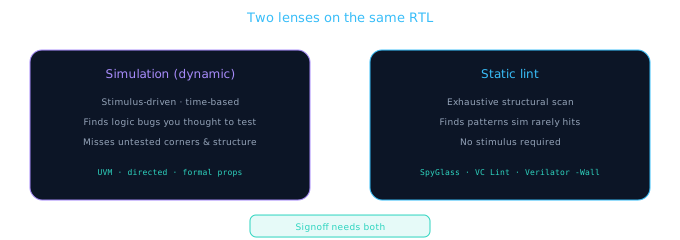
Simulation proves behavior on exercised paths. Lint audits structure on every line, every module, every clock domain.
| Question | Simulation | Static lint |
|---|---|---|
| Is my FSM reachable? | Yes, if TB drives it | Flags unreachable states in some tools |
| Is there a combo loop? | May oscillate or X-prop | Reports loop before sim runs |
| Is reset synchronized? | Only if you check release timing | Flags async reset on sequential logic |
| CDC crossing safe? | Needs metastability injection | Flags missing synchronizers |
Why companies gate merges on lint
At scale, lint is a quality firewall. One engineer's "minor waiver" becomes ten thousand violations across a SoC. Merge gates enforce a zero-tolerance policy on error-severity rules and cap waivers with documented justification.
Early bug cost
A latch found in lint costs minutes. The same latch found post-silicon costs millions.
Review bandwidth
Human reviewers cannot grep 500k lines for CDC. Lint automates the boring, critical checks.
Downstream tools
Synthesis, STA, and formal all assume lint-clean clock/reset topology.
"We'll clean lint before tapeout" never works. Violations compound, waivers become tribal knowledge, and nobody owns the 4,000 warnings filed under "legacy IP."
Common lint rule families
Commercial tools ship thousands of rules. Teams enable subsets per block type (combo datapath vs clocked control). These families appear in almost every signoff deck:
| Family | What it catches | Example rule ID |
|---|---|---|
| Latch / incomplete assignment | Combo logic without full assignment | INFERRED_LATCH |
| Multi-driven nets | Two drivers on same wire | MULTIPLE_DRIVER |
| Clock rules | Gated clocks, clock as data, mixed edges | CLK_AS_DATA |
| Reset rules | Async reset misuse, reset as clock | RST_SYNC_RELEASE |
| CDC / RDC | Crossings without synchronizers | CDC_NO_SYNC |
| Combo loops | Zero-delay feedback paths | COMBO_LOOP |
| Coding style | Blocking in seq, implicit nets | BLOCKING_IN_FF |
// BAD: pragma silences tool — hardware unchanged
// spyglass disable_block INFERRED_LATCH
always @(*) begin
  if (sel) y = a;
  // y holds when !sel → latch inferred
end
// spyglass enable_block INFERRED_LATCH

// GOOD: fix the RTL, no waiver needed
always @(*) begin
  y = 1'b0;          // default covers all inputs
  if (sel) y = a;
end
Where lint runs in the flow
Modern flows run lint at three checkpoints: per-commit CI (fast rules), nightly full-chip (CDC/RDC), and pre-tapeout signoff (waived-only-with-VP-approval).
- Block lint: designer runs locally before opening PR — 5-minute feedback loop
- SoC lint: integration team runs on stitched netlist — catches cross-module CDC
- Equivalence: lint on post-synth netlist confirms no clock-gating surprises
Module 9 scope: Lessons 9.1–9.4 cover lint families and reading reports. Lessons 9.5–9.6 introduce CDC mindset and synchronizer structures — with a deep dive in the CDC course.
Starter lint mindset for designers
// Patterns that pass most lint decks on first run
module lint_clean_combo (
  input  wire       clk,
  input  wire       rst_n,
  input  wire [1:0] sel,
  input  wire [7:0] a, b,
  output reg  [7:0] y
);
  // Rule: one driver per signal — use reg + always, not assign + always
  always @(*) begin
    y = 8'h00;                    // default → no latch
    case (sel)
      2'b00: y = a + b;
      2'b01: y = a - b;
      2'b10: y = a & b;
      default: y = a | b;
    endcase
  end

  // Rule: sequential logic — single clock, sync reset
  reg [7:0] hold;
  always @(posedge clk) begin
    if (!rst_n) hold <= 8'h00;
    else        hold <= y;
  end
endmodule
- Run lint before requesting code review — not after reviewer comments
- Treat ERROR severity as a compile failure
- Never waive without understanding root cause
- Keep a team waiver database with owner, expiry, and fix plan
- Match lint rules to synthesis constraints — same clock definitions
Tool landscape — same rules, different UIs
Whether your team uses Synopsys SpyGlass, Cadence JasperGold CDC, Siemens Questa Lint, or open-source Verilator with -Wall, the underlying checks overlap heavily. Learn the rule families (lesson 9.1 table) and you can navigate any report.
| Tool | Typical use | Designer entry point |
|---|---|---|
| SpyGlass / VC Lint | Block + SoC signoff | sg_shell or CI dashboard |
| Verilator lint | Fast pre-commit, open source | verilator --lint-only -Wall |
| Questa RDC | Reset-domain crossing | Paired with CDC deck |
| Formal CDC | Prove sync structures | Integration / signoff team |
Fast loop
Run lightweight lint locally before every push — catch latches in seconds.
Nightly full
SoC-level CDC/RDC runs on stitched RTL — catches cross-module issues.
Signoff
Zero ERROR + audited waivers = tapeout gate.
What reviews miss without lint
Human review excels at architecture and protocol correctness. It is poor at exhaustively checking every always block for latch inference across 200 files. Typical post-silicon surprises that lint would have caught:
- Incomplete case in a decode block used only in test mode — never stimulated in sim
- Clock used as enable on a status flop — passes fast sim, fails STA
- Multi-driver bus from overlapping assign and always blocks
- CDC pulse stretched wrong — works at room temp, fails at cold
Arguing "my simulation passed" in a lint review is a red flag. Simulation coverage and structural correctness are orthogonal axes.
# Fast open-source lint before every commit
verilator --lint-only -Wall --timing \
  -Wno-DECLFILENAME \
  rtl/my_block.v 2>&1 | tee lint.log

grep -E "Error|%Error" lint.log && exit 1
echo "Lint clean — safe to open PR"
# Pre-review lint checklist (designer)
[ ] Block lint ERROR count = 0
[ ] No new waivers without justification ticket
[ ] Clock names match SDC / block diagram
[ ] All combo blocks use always @(*) with defaults
[ ] CDC outputs documented (even if "no crossings")
[ ] Lint report attached to PR description
🎯 What to remember
- Static lint scans RTL structure; simulation exercises behavior — you need both.
- Merge gates exist because lint violations scale badly and silicon is unforgiving.
- Rule families: latches, multi-drive, clocks, resets, CDC, combo loops, coding style.
- Fix RTL first; waivers are audited exceptions, not a workflow.
- Next: the three structural bugs lint catches most often — latches, loops, and multi-drivers.