Stalls, bubbles & flush
Hazard fixes boil down to three control actions: stall (freeze a stage), bubble (insert a NOP), and flush (squash wrong-path ops). This lesson wires them into pipeline register enable/clear logic.
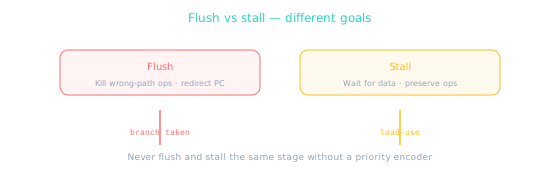
Stall = hold register values, block upstream advance. Bubble = let a stage advance but force NOP semantics. Flush = overwrite in-flight ops with harmless NOPs on redirect.
Stall signals — who freezes?
A global stall is rare. Typical design: per-stage stall_X derived from hazard logic. When ID/EX stalls, IF/ID must also stall (otherwise you overwrite the instruction waiting in ID).
| Signal | Effect on register | Upstream |
|---|---|---|
stall_if_id | IF/ID holds current instr | PC does not advance |
stall_id_ex | ID/EX holds; IF/ID must stall too | Insert bubble into EX if needed |
stall_ex_mem | EX/MEM holds; all prior stages stall | Memory port stays busy |
The key rule: stall propagates backward. If ID/EX cannot advance, IF/ID must hold too — otherwise the instruction in ID gets overwritten by the next fetch. Only stages downstream of the hazard may continue (often with a bubble inserted).
Debug halt, reset sequencing, or clock-gate handshakes sometimes assert stall_all. Every PC and pipeline register freezes. Do not mix global stall with per-stage stall without OR-combining into each stage's final stall signal.
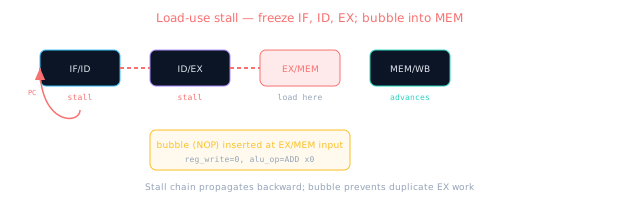
// Load-use: LW in EX/MEM, dependent op in ID/EX
wire load_use_stall =
     id_ex_mem_read &&
     (id_ex_rs == ex_mem_rd || id_ex_rt == ex_mem_rd) &&
     ex_mem_rd != 5'd0;

assign stall_if_id = load_use_stall;
assign stall_id_ex = load_use_stall;
assign stall_pc    = load_use_stall;

// Bubble into EX/MEM (advance ID/EX into EX with NOP)
assign bubble_ex_mem = load_use_stall;
// Backward stall propagation — one source of truth
wire hazard_stall_id_ex = load_use_stall | mul_stall;  // example

assign stall_id_ex = hazard_stall_id_ex;
assign stall_if_id = hazard_stall_id_ex;   // must match ID/EX
assign stall_pc    = hazard_stall_id_ex;   // PC frozen with IF/ID

// EX/MEM and MEM/WB keep advancing unless separately stalled
assign stall_ex_mem = mem_wait | div_stall;
Inserting a bubble (NOP)
A bubble is a pipeline slot that looks like a valid instruction but has no side effects. In RISC-V, addi x0, x0, 0 is the canonical NOP. Two mechanisms:
Bubbles differ from stalls: with a stall the pipeline register holds its value; with a bubble the register advances but the payload is forced to NOP semantics. Load-use needs both — stall upstream stages so the dependent op waits, and bubble into EX so the ALU does not re-execute garbage.
- Stall + bubble: upstream frozen, current stage receives forced NOP on next edge
- Flush to NOP: overwrite register fields with safe defaults
localparam NOP = 32'h00000013; // addi x0,x0,0

wire [31:0] id_ex_instr_next =
  bubble_ex_mem ? NOP : id_ex_instr_in;

wire id_ex_reg_write_next =
  bubble_ex_mem ? 1'b0 : id_ex_reg_write_in;

wire id_ex_mem_read_next =
  bubble_ex_mem ? 1'b0 : id_ex_mem_read_in;
Inserting only an instruction NOP without clearing mem_write or branch flags still causes side effects. A bubble must zero all control signals, not just the opcode field.
Flush on redirect
When a branch resolves taken (or interrupt fires), wrong-path instructions in IF and ID must not commit. Flush overwrites pipeline registers with NOP and clears control signals.
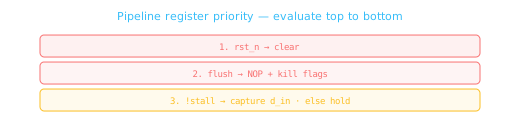
Same priority in every stage register — inconsistent ordering across IF/ID vs ID/EX causes subtle sim/synth mismatches.
wire branch_flush = ex_branch_taken;
wire irq_flush    = irq_pending && ex_allow_irq;

// Priority: irq > branch > normal
wire flush_if_id = irq_flush | branch_flush;
wire flush_id_ex = irq_flush;  // branch may only flush IF/ID

assign pc_next = irq_flush    ? irq_vector :
                 branch_flush ? ex_target :
                                pc_plus4;
If flush and stall assert together on the same register without priority, synthesis may produce X in simulation or glitch enables. Define explicit priority: if (flush) ... else if (!stall) ...
Enable / clear pipeline registers — full pattern
The canonical pipeline register template handles reset, flush (clear), stall (hold), and normal advance in one always block.
module pipeline_reg #(
  parameter WIDTH = 32
) (
  input  wire             clk,
  input  wire             rst_n,
  input  wire             stall,   // 1 = hold
  input  wire             flush,   // 1 = load zero/NOP
  input  wire [WIDTH-1:0] d_in,
  output reg  [WIDTH-1:0] q_out
);
  localparam [WIDTH-1:0] CLR = {WIDTH{1'b0}};

  always @(posedge clk or negedge rst_n) begin
    if (!rst_n)
      q_out <= CLR;
    else if (flush)
      q_out <= CLR;           // clear / NOP payload
    else if (!stall)
      q_out <= d_in;          // enable: capture
    // else hold — implicit stall
  end
endmodule
// ID/EX bundle — flush kills all side-effect flags
always @(posedge clk or negedge rst_n) begin
  if (!rst_n) begin
    id_ex_valid      <= 1'b0;
    id_ex_reg_write  <= 1'b0;
    id_ex_mem_write  <= 1'b0;
    id_ex_alu_src_a  <= 32'h0;
  end else if (flush_id_ex) begin
    id_ex_valid      <= 1'b0;
    id_ex_reg_write  <= 1'b0;
    id_ex_mem_write  <= 1'b0;
    id_ex_instr      <= NOP;
  end else if (!stall_id_ex) begin
    id_ex_valid      <= 1'b1;
    id_ex_reg_write  <= id_reg_write;
    id_ex_mem_write  <= id_mem_write;
    id_ex_alu_src_a  <= rs1_data;
    id_ex_instr      <= if_id_instr;
  end
end
Stall vs bubble vs flush — decision table
| Situation | Action | PC advances? |
|---|---|---|
| Load-use hazard | Stall IF/ID/ID/EX + bubble EX | No |
| Structural mem conflict | Stall IF only | No |
| Branch mispredict | Flush IF/ID, redirect PC | Yes (to target) |
| Interrupt | Flush all in-flight, save CSR | Yes (to vector) |
| Debug halt | Global stall all stages | No |
When multiple conditions can fire in the same cycle (e.g. load-use stall during a taken branch), define explicit priority in your hazard unit. Typical choice: interrupt flush > branch flush > structural stall > load-use stall — document it in the spec.
Simulation tip: Log stall, flush, and pc every cycle in your testbench. Most pipeline bugs show up as a missing stall or a flush that doesn't clear mem_write.
Control checklist
- Stall propagates backward from the stage that cannot advance
- Bubble path zeros reg_write, mem_write, and branch flags
- Flush priority documented (irq > branch > normal)
- Pipeline regs use if/else-if: flush before stall before capture
- TB covers load-use stall and taken-branch flush in same run
- Multi-hazard priority tested (stall during flush edge case)
Combining stall and flush in one cycle
Real designs see overlapping conditions — e.g. a load-use stall on the same cycle a debug interrupt fires. Your hazard unit must resolve them without ambiguous register behavior.
// Final stall/flush per stage — single assignment each
wire stall_if_id_raw = load_use_stall | struct_stall;
wire flush_if_id_raw = irq_flush | branch_flush;

// Flush wins over stall on IF/ID (redirect kills fetch anyway)
wire stall_if_id = stall_if_id_raw && !flush_if_id_raw;
wire flush_if_id = flush_if_id_raw;

// ID/EX: irq may flush; load-use stalls without flush
wire stall_id_ex = load_use_stall && !irq_flush;
wire flush_id_ex  = irq_flush;
Constrained-random instruction streams catch priority bugs that directed tests miss. Seed your RNG and assert $stable(pc) whenever stall_pc is high — PC must not advance during stall.
🎯 What to remember
- Stall freezes registers; bubble inserts harmless NOP; flush kills wrong-path work.
- Load-use needs stall + bubble — forwarding alone cannot fix it.
- Pipeline register template: reset → flush → stall → enable, in that priority.
- Always clear side-effect flags on flush, not just the instruction field.