Pipeline hazards — structural, data & control
When multiple operations overlap in a pipeline, hazards threaten correctness or stall progress. Every pipelined block needs a hazard plan: detect, forward, stall, or flush.
You will implement pieces of this plan across the next three lessons — stalls and bubbles (8.3), forwarding (8.4), then the pipelined ALU lab (8.5) where they all connect.
A condition where the pipeline would produce the wrong result, or two stages need the same hardware at the same time, unless you intervene with control logic.
Three hazard families
| Type | Cause | Typical fix |
|---|---|---|
| Structural | Two stages need same resource (ALU, memory port) | Duplicate hardware, schedule, or stall |
| Data | Operand not ready when consumer needs it | Forwarding, stall, or compiler scheduling |
| Control | Branch/jump changes PC before pipe drains | Flush wrong-path ops, predict branch |
Hazards are not bugs — they are the price of overlapping operations. Your job is to pick the cheapest fix per case: duplicate hardware beats stall if area allows; forward beats stall if timing allows; predict beats flush if accuracy is high.
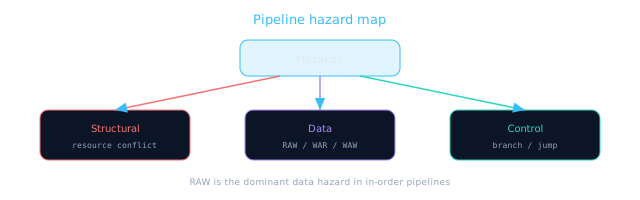
Design order: Eliminate structural conflicts first (memory ports, single ALU), then add forwarding for RAW, then stall logic for load-use, then branch flush/predict for control. Each layer builds on the previous — skipping structural fixes makes stall logic a band-aid.
Structural hazards
Occurs when two pipeline stages need the same non-pipelined resource in the same cycle — e.g. instruction fetch and data load both hitting single-port memory.
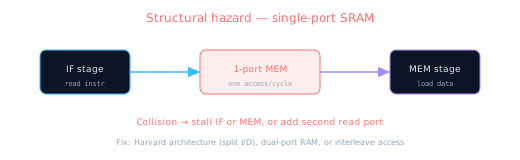
Modern SoCs rarely share one physical port between IF and MEM — but the pattern repeats everywhere: one DMA engine vs CPU, one AXI port vs two masters, one multiplier vs two MAC lanes. The RTL pattern is identical: arbitrate, stall the lower-priority client, or duplicate the resource.
Dual-port SRAM costs ~1.6–2× the area of single-port at the same depth. If structural stalls happen <5% of cycles, a cheap arbiter + stall is often the right call. If stalls dominate, pay for the second port.
// Simple structural hazard arbiter — MEM wins over IF
wire mem_req = mem_stage_active && mem_read_en;
wire if_req  = if_stage_active  && !mem_req;

assign mem_port_en   = mem_req;
assign mem_port_addr = mem_req ? mem_addr : if_pc;
assign if_stall      = mem_req && if_req;  // IF waits for port
Data hazards — RAW, WAR, WAW
Data hazards appear when instruction B needs a value that instruction A has not finished writing. In RTL you detect them by comparing destination registers in later stages against source registers in EX.
| Name | Pattern | In-order pipe? |
|---|---|---|
| RAW (Read After Write) | Consumer reads before producer writes | Yes — most common; needs forward or stall |
| WAR (Write After Read) | Writer overwrites before reader finishes | Rare in classic 5-stage; issue in OoO rename |
| WAW (Write After Write) | Two writers, wrong commit order | Rare in-order; rename handles in OoO |
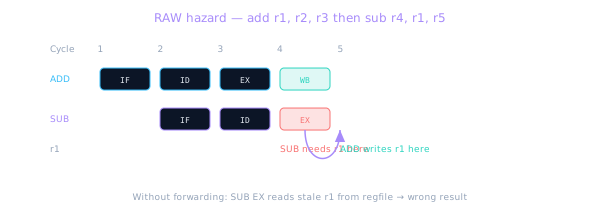
// RAW detect: EX-stage consumer needs register written by prior op
wire raw_hazard =
     ex_reg_read_en && ex_rs_addr != 5'd0 && (
       (mem_reg_write && mem_rd_addr == ex_rs_addr) ||
       (wb_reg_write  && wb_rd_addr  == ex_rs_addr)
     );

// Action: assert forward mux select OR stall EX/ID
// Combine hazard outputs — priority: structural stall overrides forward
wire stall_from_struct = mem_port_busy && if_mem_conflict;
wire stall_from_load   = load_use_hazard;
wire stall_if_id       = stall_from_struct | stall_from_load;
wire stall_id_ex       = stall_from_load;

wire use_fwd_a = raw_hazard_rs1 && !stall_from_load;
wire use_fwd_b = raw_hazard_rs2 && !stall_from_load;

// load-use: stall wins — forwarding cannot supply data yet
In a simple in-order pipeline with one writeback per cycle, WAR and WAW rarely appear because reads happen in ID and writes in WB — strictly ordered. They matter when you add bypass paths, dual-issue, or out-of-order retirement. Know the names; focus RTL effort on RAW.
Detecting RAW on x0 as destination causes false stalls — RISC-V x0 is not a real register. Always gate with rd != 5'd0 on both producer and consumer sides.
Control hazards — branches & jumps
Branch outcome is known in EX (or later). Meanwhile IF/ID already fetched fall-through or wrong-target instructions. You must flush the wrong path.
The penalty is measured in lost fetch slots: a 5-stage pipe with branch in EX typically wastes 2 instructions (IF + ID) per taken branch. Branch prediction moves the penalty to mispredicts only — covered in advanced CPU design; for now implement correct flush-on-taken.
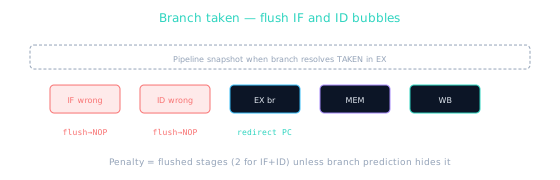
wire branch_taken = ex_branch && ex_cond_true;
wire flush_if_id  = branch_taken;
wire flush_id_ex  = branch_taken;  // optional if branch in EX

assign next_pc = branch_taken ? ex_target_pc : pc_plus4;

// IF/ID registers load NOP when flush_if_id asserted
Forgetting to squash reg_write on flushed ops can corrupt the register file. Flush must zero side effects: no writeback, no memory store, no CSR update.
Unconditional jumps also need PC redirect + flush, but there is no "not taken" path — every jump is a control hazard. Link register write (rd=ra) must still commit from the jump instruction in EX while IF/ID flush.
Hazard response summary
Use this table as your implementation checklist. When sim fails on a dependent instruction pair, identify which row applies before randomly adding stalls.
| Hazard | Detect | Fix priority |
|---|---|---|
| Structural | Resource busy signal | Stall lower-priority stage; add port if frequent |
| RAW (EX needs WB) | Addr match + reg_write | Forward from MEM/WB; else stall 1 cycle |
| Load-use RAW | Load in MEM, use in EX | Must stall — data not ready until WB |
| Control | Branch resolved taken | Flush IF/ID; redirect PC; predict to hide |
Hazard checklist
- Every shared resource has arbitration or duplicate hardware
- RAW detection covers EX/MEM and EX/WB paths
- Load-use case identified — forwarding alone is insufficient
- Branch flush kills side effects on wrong-path ops
- Simulation includes back-to-back dependent instructions
- Structural arbiter priority documented (MEM vs IF)
Simulating hazards in your testbench
Pipeline bugs rarely show on isolated instructions. Build directed tests that exercise each hazard row in the summary table — one test per row, run back-to-back in the same sim.
// Directed hazard tests — run sequentially in one sim
task test_raw_alu_alu;  // ADD then SUB on same reg — expect forward
  reset_pipe();
  inject_instr(ADD, rd=1, rs1=2, rs2=3);
  inject_instr(SUB, rd=4, rs1=1, rs2=5);
  @(posedge clk); @(posedge clk); @(posedge clk);
  check_reg(4, expected_sub_result);
endtask

task test_load_use;     // LW then ADD — expect 1-cycle stall
  reset_pipe();
  inject_instr(LW,  rd=1, rs1=2);
  inject_instr(ADD, rd=3, rs1=1, rs2=4);
  monitor_stall(1);  // exactly one stall cycle
endtask

task test_branch_taken; // branch + wrong-path ops — expect flush
  reset_pipe();
  inject_instr(BEQ, taken=1, target=0x100);
  inject_instr(ADD, ...);  // wrong path — must not write
  @(posedge clk);
  check_no_reg_write_from_wrong_path();
endtask
Debug tip: Waveform markers at stall_if_id, flush_if_id, and fwd_a_sel let you correlate a wrong register value with the exact cycle the hazard unit failed.
🎯 What to remember
- Structural = hardware conflict; data = wrong operand timing; control = wrong PC path.
- RAW dominates in-order RTL — detect register addr match across stages.
- WAR/WAW matter in advanced cores; know them, don't over-engineer a simple pipe.
- Every hazard fix is stall, forward, flush, or duplicate — pick the cheapest that meets timing.
- Directed TB tasks per hazard type catch regressions before full program sims.