Adders & comparators — think hardware cost, not only code
In software, a + b feels free. In silicon, every add is a chain of carry logic —
and every compare is either cheap (equality) or surprisingly expensive (less-than on wide buses).
This lesson connects ripple carry, the + operator,
== vs <, signed traps, and the
overflow flag so you can reason about cost before you write RTL.
An N-bit adder is N full-adders chained by carry. A less-than compare on unsigned values can reuse a subtractor's sign bit; signed compare needs extra care. Overflow is not the same as carry-out.
Half-adders and full-adders — the atomic units
Addition in hardware starts with two-input cells:
| Cell | Inputs | Outputs | Logic |
|---|---|---|---|
| Half-adder | a, b | sum, carry | sum = a^b, carry = a&b |
| Full-adder | a, b, cin | sum, cout | sum = a^b^cin, cout majority |
A full-adder is roughly two XOR depths for sum and a carry-propagate network. Stack N of them and you get an N-bit ripple-carry adder.
module full_adder (
  input  wire a, b, cin,
  output wire sum, cout
);
  assign sum  = a ^ b ^ cin;
  assign cout = (a & b) | (cin & (a ^ b));
endmodule
Ripple-carry adder — simple but slow
In a ripple-carry chain, bit i's carry must settle before bit i+1 can finish. Delay grows linearly with width: roughly O(N) gate delays.
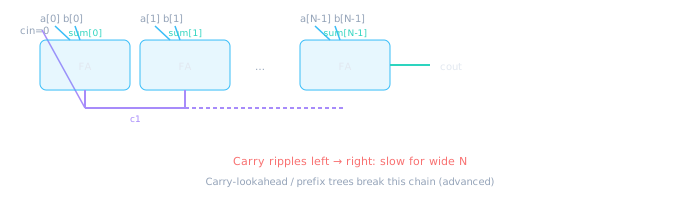
Ripple carry is pedagogically clear; production wide adders use faster carry networks.
module ripple_add #(
  parameter WIDTH = 8
) (
  input  wire [WIDTH-1:0] a, b,
  input  wire             cin,
  output wire [WIDTH-1:0] sum,
  output wire             cout
);
  wire [WIDTH:0] carry;
  assign carry[0] = cin;
  genvar i;
  generate
    for (i = 0; i < WIDTH; i = i + 1) begin : gen_add
      full_adder u_fa (
        .a(a[i]), .b(b[i]), .cin(carry[i]),
        .sum(sum[i]), .cout(carry[i+1])
      );
    end
  endgenerate
  assign cout = carry[WIDTH];
endmodule
Ripple carry is like a line of people passing a message — each person waits for the previous one to finish before speaking. Carry-lookahead is everyone shouting their partial answer at once and combining in parallel.
The + operator — what synthesis actually builds
Verilog + on unsigned vectors synthesizes to an adder. The tool picks ripple, carry-lookahead, or a hard macro depending on width, timing constraints, and target (FPGA DSP block vs ASIC cell).
| RTL line | Typical hardware | Cost note |
|---|---|---|
assign y = a + b; | N-bit adder | One adder per expression |
y = a + b + c; | Often 2 adders or 1 wider tree | Don't assume C merges for free |
a + 1 | Incrementer (cheaper than general add) | Constant operand helps tools |
a - b | Adder + inverted b + cin=1 | Same cost class as add |
module add_simple #(
  parameter WIDTH = 16
) (
  input  wire [WIDTH-1:0] a, b,
  output wire [WIDTH-1:0] sum,
  output wire             carry_out
);
  // Synthesis infers adder — width must be explicit
  assign {carry_out, sum} = a + b;
endmodule
Width trap: assign y = a + b; when a is 8 bits and y is 8 bits silently discards carry-out. If you need overflow detection, widen the result to WIDTH+1 bits first.
Comparators — equality vs less-than
Equality (==): XOR each bit pair, NOR the results — very cheap, shallow logic, one gate depth per bit plus a tree.
Less-than (<): For unsigned, compute a - b and check the MSB (borrow/sign). That's essentially a subtractor — much heavier than equality.
| Compare | RTL | Hardware cost |
|---|---|---|
| Equal | a == b | Low — XOR + NOR tree |
| Not equal | a != b | Low — invert equal |
| Unsigned < | a < b | Medium — subtractor path |
| Unsigned > | a > b | Medium — swap operands |
module compare8 (
  input  wire [7:0] a, b,
  output wire       eq,
  output wire       lt_unsigned
);
  assign eq          = (a == b);
  assign lt_unsigned = (a < b);   // unsigned by default for wire vectors
endmodule
Signed compare traps
Verilog treats plain wire vectors as unsigned. Signed comparison requires $signed() cast or declaring operands as signed types in SystemVerilog.
a < b when a = 8'hFF (-1 signed) and b = 8'h01 (1) returns false unsigned (255 < 1 is false) but true signed (-1 < 1). This bug ships in production FIFO pointer compares.
module signed_compare8 (
  input  wire signed [7:0] a, b,   // SV: signed declaration
  output wire              lt_signed
);
  assign lt_signed = (a < b);     // signed compare
endmodule

// Verilog-2001 style cast
wire lt_sv;
assign lt_sv = ($signed(a) < $signed(b));
Document compare semantics in the module header: "All compares unsigned unless noted." Reviewers grep for < and > on counters and pointers — signed mistakes are a top-10 RTL bug class.
Overflow flag vs carry-out
These are not interchangeable:
- Carry-out (C): Bit N of
a + b— meaningful for unsigned wrap and multi-precision add. - Overflow (V): Signed overflow — result doesn't fit in N-bit two's complement. True when adding two positives gives negative, or two negatives gives positive.
| a (signed) | b | sum 8-bit | C | V (overflow) |
|---|---|---|---|---|
| +127 | +1 | -128 | 0 | 1 |
| +1 | +1 | +2 | 0 | 0 |
| -1 | -1 | -2 | 1 | 0 |
module add_with_flags #(
  parameter WIDTH = 8
) (
  input  wire [WIDTH-1:0] a, b,
  output wire [WIDTH-1:0] sum,
  output wire             carry,    // unsigned carry-out
  output wire             overflow  // signed overflow
);
  wire [WIDTH:0] wide_sum;
  assign wide_sum = a + b;
  assign sum      = wide_sum[WIDTH-1:0];
  assign carry    = wide_sum[WIDTH];
  // V = (a[N-1] == b[N-1]) && (sum[N-1] != a[N-1])
  assign overflow = (~(a[WIDTH-1] ^ b[WIDTH-1])) &
                    (a[WIDTH-1] ^ sum[WIDTH-1]);
endmodule
Hardware cost on a real datapath
Imagine a 32-bit ALU path that must add, subtract, and compare every cycle. Rough relative costs:
Cheap
Equality, bitwise AND/OR/XOR, increment by 1, mux select.
Medium
General add/sub, unsigned <, shift by constant.
Expensive
Multiple parallel adders, wide signed compares every cycle, variable shifts.
Sharing wins: One adder can serve ADD and SUB (invert B, cin=1) and unsigned < (check subtract sign). Don't instantiate three subtractors if one shared adder with muxed operands suffices.
Design checklist
- Declare vector widths explicitly — never rely on implicit 32-bit integers
- Widen to WIDTH+1 when you need carry-out or overflow
- Document signed vs unsigned compare policy in header comments
- Use
$signed()or SVsignedkeyword deliberately, not accidentally - Share one adder for add/sub/compare when timing allows
- Overflow ≠ carry — implement the flag your ISA spec actually needs
🎯 What to remember
- Ripple carry is O(N) delay — fine for narrow, problematic for 32+ bits at high Fmax.
+synthesizes to real adders — chaining adds costs real area.==is cheap;<is subtractor-class expensive.- Unsigned default bites signed algorithms — cast or declare signed.
- Overflow flag answers a different question than carry-out.