Combinational ALU building blocks
An ALU is the datapath workhorse: it computes on two operands and exposes
status flags the rest of the chip consumes. Here we build a clean, parameterized
combinational ALU from the primitives you already know — opcode mux, shared adder, bitwise ops,
shifts, and the classic Z / N / C flags — using one well-structured
always @(*) block.
Compute all candidate results in parallel, then mux the opcode-selected result to the output. Flags are derived from the selected result (and carry for arithmetic ops). Parameterize WIDTH once — reuse everywhere.
ALU datapath architecture
A typical combinational ALU has two operand buses, a 3–4 bit opcode, one result bus, and a few flag outputs. Everything settles in one cycle (no registers inside the ALU itself).
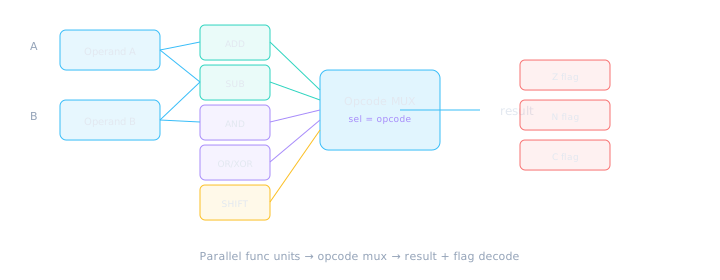
Synthesis may share adder for ADD/SUB; the conceptual model is parallel compute + select.
Opcode map — localparam discipline
Never scatter raw opcode values. Name them once with localparam — your case statement, decoder, and testbench all reference the same names.
| Opcode | Operation | Result |
|---|---|---|
OP_ADD (0) | Add | a + b |
OP_SUB (1) | Subtract | a - b |
OP_AND (2) | Bitwise AND | a & b |
OP_OR (3) | Bitwise OR | a | b |
OP_XOR (4) | Bitwise XOR | a ^ b |
OP_SHL (5) | Shift left | a << 1 |
OP_PASS (6) | Pass A | a |
| default (7) | Pass B | b |
localparam OP_ADD  = 3'd0;
localparam OP_SUB  = 3'd1;
localparam OP_AND  = 3'd2;
localparam OP_OR   = 3'd3;
localparam OP_XOR  = 3'd4;
localparam OP_SHL  = 3'd5;
localparam OP_PASS = 3'd6;
// 3'd7 reserved or OP_PASS_B
Status flags — Z, N, C
Flags summarize the result for branch logic and interrupt handlers. Our minimal set:
| Flag | Name | Meaning | RTL |
|---|---|---|---|
| Z | Zero | Result is all zeros | result == 0 |
| N | Negative | MSB of result (signed sign) | result[WIDTH-1] |
| C | Carry | Unsigned carry-out of add/sub | From wide arithmetic |
Flags are the ALU's facial expression — the datapath does the math, but Z/N/C tell the control unit "was it zero?", "was it negative?", "did we spill past the cup rim?" without re-reading the full result bus.
Computing Z/N from the wrong intermediate — e.g. flags from a+b while opcode selected AND — causes branch bugs that only show on certain instructions. Flags must follow the muxed result (and carry from the arithmetic path when relevant).
Full parameterized ALU — clean always @(*)
This is the reference implementation. One combinational block owns result and flags. Default assignments at the top prevent latches. Full case on opcode.
module combo_alu #(
  parameter WIDTH = 8
) (
  input  wire [WIDTH-1:0] a,
  input  wire [WIDTH-1:0] b,
  input  wire [2:0]       opcode,
  output reg  [WIDTH-1:0] result,
  output reg              flag_z,
  output reg              flag_n,
  output reg              flag_c
);
  localparam OP_ADD  = 3'd0;
  localparam OP_SUB  = 3'd1;
  localparam OP_AND  = 3'd2;
  localparam OP_OR   = 3'd3;
  localparam OP_XOR  = 3'd4;
  localparam OP_SHL  = 3'd5;
  localparam OP_PASS = 3'd6;

  wire [WIDTH:0] sum_wide;
  wire [WIDTH:0] sub_wide;
  assign sum_wide = a + b;
  assign sub_wide = a - b;

  always @(*) begin
    // Defaults — latch prevention
    result  = {WIDTH{1'b0}};
    flag_z  = 1'b0;
    flag_n  = 1'b0;
    flag_c  = 1'b0;

    case (opcode)
      OP_ADD: begin
        result  = sum_wide[WIDTH-1:0];
        flag_c  = sum_wide[WIDTH];
        flag_z  = (result == {WIDTH{1'b0}});
        flag_n  = result[WIDTH-1];
      end
      OP_SUB: begin
        result  = sub_wide[WIDTH-1:0];
        flag_c  = sub_wide[WIDTH];   // borrow as carry semantics
        flag_z  = (result == {WIDTH{1'b0}});
        flag_n  = result[WIDTH-1];
      end
      OP_AND: begin
        result = a & b;
        flag_z = (result == {WIDTH{1'b0}});
        flag_n = result[WIDTH-1];
      end
      OP_OR:  begin
        result = a | b;
        flag_z = (result == {WIDTH{1'b0}});
        flag_n = result[WIDTH-1];
      end
      OP_XOR: begin
        result = a ^ b;
        flag_z = (result == {WIDTH{1'b0}});
        flag_n = result[WIDTH-1];
      end
      OP_SHL: begin
        result = a << 1;
        flag_c = a[WIDTH-1];         // bit shifted out
        flag_z = (result == {WIDTH{1'b0}});
        flag_n = result[WIDTH-1];
      end
      OP_PASS: begin
        result = a;
        flag_z = (result == {WIDTH{1'b0}});
        flag_n = result[WIDTH-1];
      end
      default: begin
        result = b;
        flag_z = (result == {WIDTH{1'b0}});
        flag_n = result[WIDTH-1];
      end
    endcase
  end
endmodule
1) Declare wide arithmetic wires outside always. 2) Default all outputs inside always. 3) One case on opcode. 4) Each branch sets result + flags together. This pattern scales to 16+ opcodes without becoming unreadable.
Alternative: compute-then-mux style
Some teams pre-compute all results into wires, then mux with a single assign. Equivalent hardware, different readability trade-off.
wire [WIDTH-1:0] w_add = a + b;
wire [WIDTH-1:0] w_sub = a - b;
wire [WIDTH-1:0] w_and = a & b;
wire [WIDTH-1:0] w_or  = a | b;
wire [WIDTH-1:0] w_xor = a ^ b;
wire [WIDTH-1:0] w_shl = a << 1;

always @(*) begin
  case (opcode)
    OP_ADD:  result = w_add;
    OP_SUB:  result = w_sub;
    OP_AND:  result = w_and;
    OP_OR:   result = w_or;
    OP_XOR:  result = w_xor;
    OP_SHL:  result = w_shl;
    OP_PASS: result = a;
    default: result = b;
  endcase
  flag_z = (result == {WIDTH{1'b0}});
  flag_n = result[WIDTH-1];
end
Synthesis note: Both styles usually produce similar netlists. The case-per-opcode style makes per-op carry semantics explicit; the mux style centralizes flag decode. Pick one and stay consistent across the project.
WIDTH parameter — one knob for the whole ALU
Parameterizing WIDTH lets you instantiate 8-bit ALUs for a microcontroller or 32-bit for a core without rewriting logic. All buses, zero compares, and MSB index scale automatically.
// 8-bit ALU for peripheral datapath
combo_alu #(.WIDTH(8)) u_alu8 (
  .a(a8), .b(b8), .opcode(op),
  .result(r8), .flag_z(z), .flag_n(n), .flag_c(c)
);

// 32-bit ALU — same module, wider parameter
combo_alu #(.WIDTH(32)) u_alu32 (
  .a(a32), .b(b32), .opcode(op),
  .result(r32), .flag_z(z), .flag_n(n), .flag_c(c)
);
Opcode mux = lesson 4.1 in practice
The ALU result mux is a textbook N:1 mux on width WIDTH. Your decoder lesson connects directly: an instruction decoder can drive opcode from a one-hot control bus converted to binary, or from register fields.
Mux (4.1)
Selects one of N pre-computed datapath results.
Adder (4.2)
Shared add/sub paths with wide carry for C flag.
Flags
Post-mux decode — Z/N from result, C from arithmetic.
ALU RTL checklist
parameter WIDTHon all internal buses and compares- Opcode values named with
localparam - Single
always @(*)owns result and flags - Default assignments before
case— no latches - Full
casewithdefaultfor unused opcodes - Flags computed from muxed
result, not stale intermediates - Module header documents signed/unsigned and flag semantics
🎯 What to remember
- ALU = parallel function units + opcode mux + flag decode.
- ADD/SUB/AND/OR/XOR/shift/pass cover most teaching and many real ISAs.
- Z = zero, N = MSB, C = carry/borrow/shift-out — define C per opcode.
- Parameter WIDTH once; instantiate at 8, 16, or 32 without rewriting.
- Clean
always @(*): defaults first, full case, flags with result.