Continuous assign vs always — when to use which
Verilog gives you two ways to describe logic: continuous assign and always blocks. Both can build combinational or sequential circuits — but only when paired with the right sensitivity list and assignment operator. This lesson maps each construct to hardware.
assign for simple combo connections. always @(*) for procedural combo. always @(posedge clk) for sequential. Never mix drivers.
Continuous assign — always "on"
A continuous assignment drives a wire whenever any signal on the right-hand side changes. In simulation it behaves like a permanent wire connection; in synthesis it becomes combinational logic.
wire y, carry;
assign y      = a ^ b;
assign carry  = a & b;

// Conditional (mux) with assign
wire [7:0] result;
assign result = sel ? b : a;

// Vector operations
wire [3:0] nibble;
assign nibble = data[7:4];
| Feature | assign |
|---|---|
| Target type | wire only |
| Evaluation | Continuous — re-evaluates on any RHS change |
| Synthesis | Combinational logic only |
| Best for | Simple gates, muxes, bit slices, connects |
| Multiple statements? | One per assign; use multiple assign lines |
assign is like soldering two points together — the output is permanently "listening" to the inputs. Change the input, the output updates immediately (after gate delay in sim).
always @(*) — combinational procedural
The always @(*) block (or always @(...) with full sensitivity) describes combinational logic procedurally. Use blocking assignment (=) inside. Every path must assign every output — or you get latches.
reg [7:0] result;
always @(*) begin
  case (opcode)
    3'b000: result = a + b;
    3'b001: result = a - b;
    3'b010: result = a & b;
    default: result = 8'd0;
  endcase
end
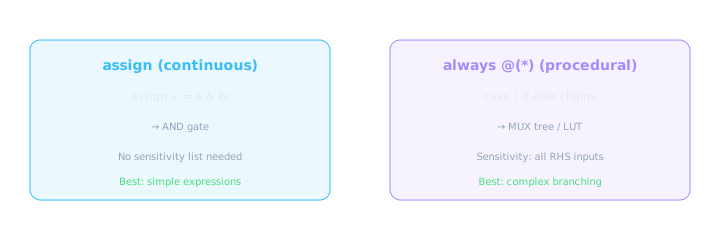
Both build combinational logic. Choose based on readability, not capability.
always @(posedge clk) — sequential
Clocked always blocks describe sequential logic. Use non-blocking assignment (<=) for flops. Include async reset in the sensitivity list when needed.
reg [7:0] count;
always @(posedge clk or negedge rst_n) begin
  if (!rst_n)
    count <= 8'd0;
  else if (en)
    count <= count + 8'd1;
end
| always form | Assignment | Hardware | Sensitivity |
|---|---|---|---|
always @(*) | = blocking | Combinational | All inputs (auto with *) |
always @(posedge clk) | <= non-blocking | Flip-flop | Clock edge (+ async reset) |
always @(a or b) | = blocking | Combo (legacy style) | Explicit signal list |
always @(posedge clk) | = blocking | ⚠️ Wrong — sim/synth mismatch | Don't do this |
Golden rule: Combo always → blocking =. Clocked always → non-blocking <=. Mixing them in a clocked block is the #1 beginner bug (next lesson).
Sensitivity lists — what triggers re-evaluation
In simulation, an always block only runs when a signal in its sensitivity list changes. Incomplete lists cause simulation/synthesis mismatches — the hardware always "sees" everything, but your sim might not.
// GOOD — @(*) auto-includes all RHS inputs
always @(*) y = a & b;

// LEGACY — manual list (error-prone)
always @(a or b) y = a & b;

// BAD — missing b in sensitivity list
always @(a) y = a & b;  // sim won't update when b changes!

// SEQUENTIAL — only clock (and async reset)
always @(posedge clk) q <= d;  // d NOT in sensitivity — correct for flops
| List style | When to use | Risk |
|---|---|---|
@(*) or @(*) | All combinational always | Low — tool fills list |
@(a or b or c) | Legacy Verilog | High — easy to omit a signal |
@(posedge clk) | Sequential | Low — only clock matters for sync logic |
@(posedge clk or negedge rst_n) | Async reset flops | Low — standard template |
Using always @(clk) instead of always @(posedge clk) — triggers on both edges in simulation, but synthesis only builds rising-edge flops. Always use explicit edge keywords.
Side-by-side: same mux, two styles
// Style A: assign (concise for simple mux)
wire [7:0] out_a;
assign out_a = sel ? b : a;
// Style B: always @(*) (better for multi-output / complex)
reg [7:0] out_b;
always @(*) begin
  if (sel)
    out_b = b;
  else
    out_b = a;
end
Both synthesize to the same 2:1 mux. Pick the style that reads clearest for your team. Many codebases use always @(*) for all combo and assign only for trivial connects.
When to use which — decision table
| Scenario | Recommended | Why |
|---|---|---|
| Simple gate (AND, XOR, invert) | assign | One line, obvious |
| 2:1 mux, bit slice | assign | Ternary is clean |
| Case statement / FSM next-state (combo) | always @(*) | Branching is readable |
| Counter, shift register, pipeline | always @(posedge clk) | Only always does sequential |
| Multiple related combo outputs | always @(*) | One block, shared logic |
| Tie-off, constant connect | assign | assign unused = 1'b0; |
assign strengths
Concise, no sensitivity worries, impossible to infer latches accidentally, great for dataflow-style RTL.
always strengths
Handles if/case/for loops, multiple outputs in one block, sequential logic, complex control flow.
What you cannot do
assigninside analwaysblock — illegal- Drive the same signal with both
assignandalways— multi-driver error - Sequential logic with
assign— no flops from assign alone - Procedural targets (
reg) withassign— type mismatch
// ILLEGAL examples — do not compile

// assign inside always
always @(*) assign x = a;  // syntax error

// dual drivers
wire y;
assign y = a;
always @(*) y = b;         // multi-driver

// flop attempt with assign
assign q = d;              // combo only — not a register!
"Can you build a flip-flop with assign?" — No. assign is purely combinational. Flops require a clocked always block (or a library cell instance).
SystemVerilog equivalents
| Verilog | SystemVerilog | Intent |
|---|---|---|
assign y = expr; | assign y = expr; | Same — continuous |
always @(*) | always_comb | Combo — tool checks completeness |
always @(posedge clk) | always_ff | Sequential — tool enforces <= |
always_comb automatically triggers once at time 0 and errors if you accidentally infer latches or write to the same variable from multiple blocks.
- I can write simple combo logic with assign
- I use always @(*) with blocking = for complex combo
- I use always @(posedge clk) with <= for flops
- I know @(*) fixes sensitivity list bugs
- I never mix assign and always on one signal
🎯 What to remember
assign= continuous combinational drive onwire.always @(*)+== procedural combinational onreg/logic.always @(posedge clk)+<== sequential (flip-flops).- Use
@(*)for auto sensitivity — never guess signal lists. - Next lesson: blocking vs non-blocking — why the assignment operator matters.