wire vs reg / logic — what is actually being stored
Verilog's wire and reg keywords confuse almost every beginner — because reg does not mean "register" in hardware. They describe how a signal is driven in the language, not always what silicon you get. SystemVerilog's logic fixes most of this.
wire = continuous connection (driven by assign or module output). reg = procedural assignment target (driven inside always). The synthesizer decides flops vs wires from context.
Historical meaning — why the names lie
Verilog-1995 inherited naming from a gate-level world:
- wire — a net, like a physical wire between gates. Value flows continuously from its driver.
- reg — a variable that can hold a value between procedural statements in simulation. The name suggests "register" but a
regin a combinationalalways @(*)becomes combinational logic, not a flip-flop.
wire is a pipe — water (signal) flows through instantly from the source. reg is a bucket you fill in procedural steps — but synthesis may replace the bucket with a pipe (combo) or a tank with a lid (flop), depending on the recipe.
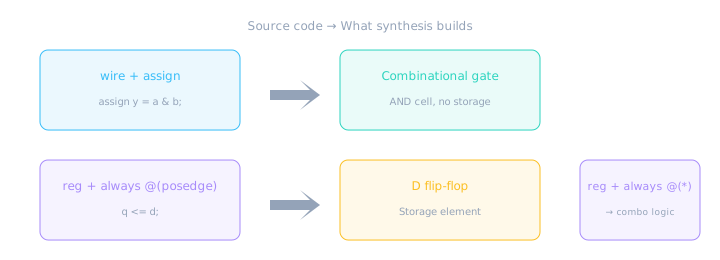
reg is NOT always a register. Context (always block type) decides the hardware.
What synthesizes to what
| Declaration | Driven by | Typical synthesis result |
|---|---|---|
wire | assign, module port, gate output | Net / routing / combo gate output |
reg in always @(posedge clk) | Non-blocking <= | Flip-flop or latch |
reg in always @(*) | Blocking = | Combinational logic (mux, adder) |
reg in initial | Procedural (TB only) | Not synthesized |
logic (SystemVerilog) | Either style | Tool infers from context |
// wire → continuous driver
wire y_combo;
assign y_combo = a ^ b;          // → XOR gate

// reg in sequential always → flop
reg q_seq;
always @(posedge clk) q_seq <= d; // → DFF

// reg in combinational always → combo
reg y_mux;
always @(*) y_mux = sel ? b : a;  // → MUX, NOT a register
Driving rules — one driver per net
Hardware nets have exactly one active driver (except tristate buses). Verilog enforces this at elaboration:
| Rule | wire | reg |
|---|---|---|
Assigned in assign? | ✓ Yes | ✗ No |
Assigned in always? | ✗ No | ✓ Yes |
Multiple assign drivers? | ✗ Error (multi-driver) | N/A |
Multiple always blocks? | N/A | ✗ Error if same reg |
| Left unassigned? | Floats to Z (sim) / tie-off (synth) | Inferred latch if combo |
// ILLEGAL — two drivers on same wire
wire x;
assign x = a & b;
assign x = c | d;   // elaboration error

// ILLEGAL — wire in always
wire bad;
always @(*) bad = a;  // error: wire cannot be procedural target

// LEGAL — one driver each
wire y1, y2;
assign y1 = a & b;
assign y2 = c | d;
Accidentally driving the same signal from an assign and an always block. Pick one style per signal — continuous or procedural, never both.
When to use wire
- Signals driven by
assignstatements - Connecting module instances (internal nets between children)
- Module
outputports when driven combinationally - Testbench signals that observe DUT outputs
module top (
  input  wire       clk,
  input  wire [7:0] din,
  output wire [7:0] dout
);
  wire [7:0] internal_sig;
  wire       carry;

  // wire driven by assign
  assign internal_sig = din + 8'd1;
  assign carry        = |din;

  child u_child (
    .clk(clk),
    .data(internal_sig),
    .cout(carry),
    .out(dout)
  );
endmodule
When to use reg
- Targets of assignments inside
alwaysblocks - Sequential state: counters, shift registers, FSM state
- Combinational logic described procedurally (prefer
logicin SV) - Testbench stimulus variables (driving DUT inputs)
module counter (
  input  wire             clk,
  input  wire             rst_n,
  input  wire             en,
  output reg  [7:0]       count   // reg because always drives it
);
  always @(posedge clk or negedge rst_n) begin
    if (!rst_n)
      count <= 8'd0;
    else if (en)
      count <= count + 8'd1;
  end
endmodule

// TB: reg drives inputs
module counter_tb;
  reg clk, rst_n, en;
  wire [7:0] count;
  // ...
endmodule
Output reg: If a module output is assigned in always, declare it output reg (Verilog) or output logic (SystemVerilog). You cannot use output wire with procedural drive.
SystemVerilog logic — the modern fix
SystemVerilog replaces the wire/reg split with a single type: logic. It can be driven by assign or always. Still one driver rule applies.
module modern_counter (
  input  logic        clk,
  input  logic        rst_n,
  output logic [7:0]  count
);
  always_ff @(posedge clk or negedge rst_n) begin
    if (!rst_n) count <= '0;
    else        count <= count + 1;
  end
endmodule

// logic works with assign too:
logic [3:0] nibble;
assign nibble = data[7:4];
| Verilog-2001 | SystemVerilog | Notes |
|---|---|---|
wire | logic (or keep wire) | logic is more flexible |
reg | logic | Drop "reg" in new code |
always @(posedge) | always_ff | Intent-clear sequential |
always @(*) | always_comb | Intent-clear combinational |
Course stance: We teach Verilog wire/reg first (industry legacy code), then introduce logic as the upgrade path. Both appear in real repos.
Inferred latches — the reg trap
If a reg is assigned in combinational always but not in every branch, synthesis infers a latch — usually unintentional.
// BAD — incomplete if → latch inferred
reg y;
always @(*) begin
  if (en) y = d;   // when en=0, y holds old value → latch!
end

// GOOD — default assignment covers all inputs
reg y_fixed;
always @(*) begin
  y_fixed = 1'b0;  // default
  if (en) y_fixed = d;
end
Enable "latch inferred" warnings in your synthesis tool. Zero latches is a common team policy unless you explicitly need one.
Quick decision flowchart
- I know reg ≠ register in hardware
- I can pick wire vs reg based on driver style
- I understand the one-driver rule
- I know logic is the SV unified type
- I watch for inferred latches in combo always
🎯 What to remember
wire= continuous assignment;reg= procedural assignment target.- reg in
always @(posedge)→ flop; reg inalways @(*)→ combo. - One driver per signal — never mix assign and always on the same net.
- SystemVerilog
logicreplaces both; usealways_ff/always_combfor clarity. - Incomplete combo branches infer latches — always default or cover all cases.