Incomplete case / sensitivity → latches
You built muxes, adders, and ALU slices — all combinational. But one missing else, one forgotten default, or one legacy always @(a) sensitivity list and synthesis quietly inserts a latch. This lesson teaches you to see the pattern, fix it with default assignments, and let lint catch it before tapeout.
Combinational logic must produce a defined output for every input combination, on every evaluation. If the tool cannot prove that, it keeps the old value — and that "memory" is a latch.
How a latch gets inferred
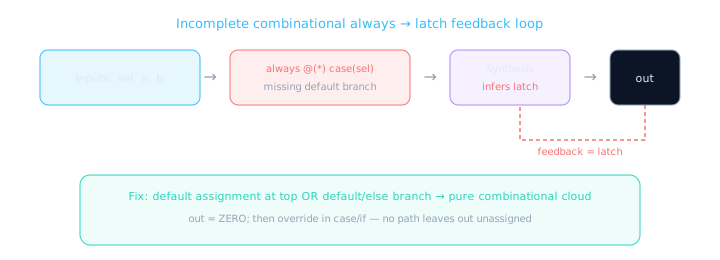
A latch is not magic — it is the tool preserving a signal when your RTL forgot to drive it.
| RTL pattern | What synthesis sees | Result |
|---|---|---|
always @(*) with full branches | Pure combinational cloud | ✅ Gates only |
case missing default | Output holds when sel hits uncovered value | ❌ Latch on out |
if without final else | Output undefined for some input combos | ❌ Latch on out |
always @(a) — partial sensitivity | Re-evaluates only when a changes | ❌ Latch + sim/synth mismatch |
| Default assign then override | Every path assigns out | ✅ Latch-free |
Think of combinational logic as a vending machine: every coin combination must dispense something. An incomplete case is a machine that sometimes keeps the last snack in the slot because you never told it what to do — that "keeping" is the latch.
Incomplete case — bad vs good
The most common latch bug in student RTL: a case that covers the opcodes you tested in sim, but not all bit patterns synthesis must handle.
// BAD — latch when sel = 2'b11
module bad_mux3 (
  input  wire [1:0] sel,
  input  wire [7:0] a, b, c,
  output reg  [7:0] out
);
  always @(*) begin
    case (sel)
      2'b00: out = a;
      2'b01: out = b;
      2'b10: out = c;
      // sel=11: out not assigned → latch inferred
    endcase
  end
endmodule
// GOOD — explicit default branch
module good_mux3 (
  input  wire [1:0] sel,
  input  wire [7:0] a, b, c,
  output reg  [7:0] out
);
  always @(*) begin
    case (sel)
      2'b00:   out = a;
      2'b01:   out = b;
      2'b10:   out = c;
      default: out = 8'h00;  // safe known value
    endcase
  end
endmodule
// GOOD — default assignment pattern (preferred in large case blocks)
module good_mux3b (
  input  wire [1:0] sel,
  input  wire [7:0] a, b, c,
  output reg  [7:0] out
);
  always @(*) begin
    out = 8'h00;           // default FIRST — latch impossible
    case (sel)
      2'b00: out = a;
      2'b01: out = b;
      2'b10: out = c;
    endcase
  end
endmodule
Assigning inside only some branches of an if/else if chain without a final else creates the same latch. if (en) out = a; with no else is a classic interview question — and a real silicon bug.
Incomplete if/else chains
Priority encoders and conditional muxes often use if/else if. Without a covering else, the last signal driven "sticks."
// BAD — latch when req = 4'b0000
always @(*) begin
  if      (req[0]) grant = 4'b0001;
  else if (req[1]) grant = 4'b0010;
  else if (req[2]) grant = 4'b0100;
  else if (req[3]) grant = 4'b1000;
  // no else — grant holds when req=0
end
// GOOD — default assignment covers all inputs
always @(*) begin
  grant = 4'b0000;                    // no request → no grant
  if      (req[0]) grant = 4'b0001;
  else if (req[1]) grant = 4'b0010;
  else if (req[2]) grant = 4'b0100;
  else if (req[3]) grant = 4'b1000;
end
Default-at-top pattern
Assign every output to a safe value first, then override in branches. Works for case, if, and FSM next-state logic.
Named default branch
Use default: in case or final else in if chains. Document whether default is error, idle, or don't-care.
Missing sensitivity — the legacy always @(a) bug
Before always @(*), engineers hand-wrote sensitivity lists. Miss one input and simulation lies while synthesis builds different hardware.
Golden rule: Use always @(*) or always_comb (SystemVerilog) for all combinational blocks. Never hand-pick signals unless you are writing a testbench.
// BAD — only re-evaluates when 'a' changes; b and sel ignored in sensitivity
always @(a) begin
  if (sel) out = a + b;
  else     out = a - b;
end
// Simulation: out stuck until 'a' toggles even if sel/b change
// Synthesis:  may still infer combo logic OR latch depending on tool
// GOOD — automatic full sensitivity
always @(*) begin
  if (sel) out = a + b;
  else     out = a - b;
end

// SystemVerilog equivalent:
// always_comb begin
//   if (sel) out = a + b;
//   else     out = a - b;
// end
| Sensitivity style | Sim behavior | Synth behavior | Verdict |
|---|---|---|---|
always @(a) | Misses updates when b/sel change | Tool-dependent; often warns | ❌ Never in RTL |
always @(a or b or sel) | Correct if list is complete | Usually OK | ⚠️ Fragile — easy to forget new signal |
always @(*) | Full automatic sensitivity | Combinational intent clear | ✅ Default choice |
full_case / parallel_case — myths, lightly
Verilog pragmas // synopsys full_case and // synopsys parallel_case tell the synthesizer "trust me, this case is complete / non-overlapping." They do not fix incomplete RTL — they silence warnings.
full_case says all input values are covered. If you lie, synthesis may optimize away "unreachable" logic that simulation still hits.
parallel_case says branches don't overlap. Wrong pragma → priority logic you didn't intend.
Modern teams prefer provably full case with default over pragmas. Let formal/lint prove coverage instead of commenting your way past warnings.
// DANGEROUS — pragma hides latch warning but logic is still incomplete
always @(*) begin
  case (sel) // synopsys full_case
    2'b00: out = a;
    2'b01: out = b;
    // 2'b10, 2'b11 uncovered — latch may still exist!
  endcase
end
// Fix the RTL; don't silence the linter.
How lint tools catch latches
Run lint on every commit. Latch inference is a high-severity finding because latches break timing closure and often indicate a logic bug.
| Tool | Typical warning | What it means |
|---|---|---|
| SpyGlass / VC Lint | Latch inferred / INFERRED_LATCH | Combo block doesn't assign all outputs in all paths |
| Verilator lint | COMBLOOP / incomplete assignment | Signal may retain value — check always block |
| Design Compiler | LINT-1 inferred latch on reg | Change to default-assign pattern or add branch |
| Vivado | [Synth 8-327] latch inferred | Same root cause — incomplete assignment |
Pro tip: Treat "latch inferred" as a blocking issue in code review — same severity as multiply-driven nets. Zero tolerance in combinational datapath modules.
Mini-labs — find and fix the latch
Paste each snippet into the simulator. Synthesis-oriented lint may not run in-browser, but you can reason about which signals are incomplete.
// LAB 1 — Fix the latch in this 2-to-4 decoder
module lab1_decoder (
  input  wire [1:0] addr,
  output reg  [3:0] dec
);
  always @(*) begin
    case (addr)
      2'b00: dec = 4'b0001;
      2'b01: dec = 4'b0010;
      2'b10: dec = 4'b0100;
      // TODO: add missing branch or default
    endcase
  end
endmodule
// Fix: default dec = 4'b0000; OR 2'b11: dec = 4'b1000;
// LAB 2 — ALU op decode with incomplete if chain
module lab2_alu_slice (
  input  wire [1:0] op,
  input  wire [7:0] a, b,
  output reg  [7:0] y
);
  always @(*) begin
    if (op == 2'b00)      y = a + b;
    else if (op == 2'b01) y = a - b;
    else if (op == 2'b10) y = a & b;
    // op==11: y not assigned → latch
  end
endmodule
// Fix: y = 8'h00; at top, or else y = a | b;
// LAB 3 — Reference solution pattern for lab2
localparam OP_ADD = 2'b00, OP_SUB = 2'b01, OP_AND = 2'b10, OP_OR = 2'b11;

always @(*) begin
  y = 8'h00;
  case (op)
    OP_ADD: y = a + b;
    OP_SUB: y = a - b;
    OP_AND: y = a & b;
    OP_OR:  y = a | b;
    default: y = 8'h00;
  endcase
end
Latch-free combinational checklist
- Every combo block uses
always @(*)— never partial sensitivity lists - Every
regoutput in combo logic has a value on every path - Default assignment at top of block OR
default/elseon every branch structure - No
full_casepragma as a substitute for real coverage - Lint run shows zero inferred-latch warnings before review
- Simulation and synthesis see the same combinational behavior
- FSM next-state logic uses the same default-assign discipline
🎯 What to remember
- Latches appear when combinational logic fails to assign every output for every input.
- Default-at-top (
out = 0;then override) is the safest latch-prevention pattern. always @(*)fixes sensitivity; it does not fix incomplete branches — you need both.- Pragmas silence warnings; they don't fix hardware. Write full case instead.
- Next up: Lab 4.5 integrates mux + ALU + decode into one clean datapath slice.