Lab: clean combinational datapath slice
Time to wire everything together. In this lab you build a single-cycle combinational datapath: operand mux → ALU function unit → flag generation, all driven by a clean opcode decode. No clocks, no latches — just the building blocks from Lessons 4.1–4.4 assembled the way real CPUs start.
Produce a synthesizable, lint-clean combo_datapath module plus a self-checking testbench you can paste into the EcrioniX Verilog simulator and run immediately.
Block diagram — what you're building
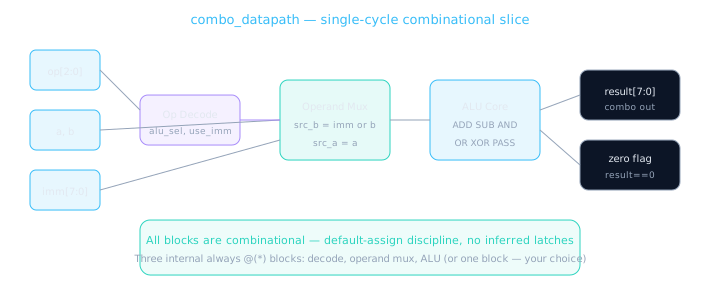
A minimal datapath slice: decode selects operands and operation; ALU computes result and zero flag.
Opcode op[2:0] | Operation | Operand B source |
|---|---|---|
3'b000 | ADD: a + b | Register b |
3'b001 | SUB: a - b | Register b |
3'b010 | AND: a & b | Register b |
3'b011 | OR: a | b | Register b |
3'b100 | XOR: a ^ b | Register b |
3'b101 | ADD imm: a + imm | Immediate imm |
3'b110 | PASS: a (copy) | Ignored |
3'b111 | CLR: output 0 | Ignored |
This slice is one row of a spreadsheet: inputs arrive, a formula is selected, a result appears — all in the same "row" with no memory between evaluations. That's combinational design.
Interface spec — read before coding
- Inputs:
op[2:0]opcode,a[7:0]andb[7:0]register operands,imm[7:0]immediate - Outputs:
result[7:0]ALU result,zeroflag (1 when result is all zeros) - Style:
always @(*), default assignments, namedlocalparamopcodes - No latches: every output assigned on every path — apply Lesson 4.4 rules
Width discipline: All operands are 8-bit. Addition/subtraction wrap on overflow — we do not implement carry-out in this lab (that's a sequential/flags extension in later modules).
Step 1 — Opcode decode block
Decode translates op into internal control signals. Default-assign first, then override per opcode.
localparam OP_ADD  = 3'b000;
localparam OP_SUB  = 3'b001;
localparam OP_AND  = 3'b010;
localparam OP_OR   = 3'b011;
localparam OP_XOR  = 3'b100;
localparam OP_ADDI = 3'b101;
localparam OP_PASS = 3'b110;
localparam OP_CLR  = 3'b111;

localparam ALU_ADD  = 3'd0;
localparam ALU_SUB  = 3'd1;
localparam ALU_AND  = 3'd2;
localparam ALU_OR   = 3'd3;
localparam ALU_XOR  = 3'd4;
localparam ALU_PASS = 3'd5;
localparam ALU_ZERO = 3'd6;

reg [2:0] alu_sel;
reg       use_imm;

always @(*) begin
  alu_sel  = ALU_ADD;
  use_imm  = 1'b0;
  case (op)
    OP_ADD:  begin alu_sel = ALU_ADD;  use_imm = 1'b0; end
    OP_SUB:  begin alu_sel = ALU_SUB;  use_imm = 1'b0; end
    OP_AND:  begin alu_sel = ALU_AND;  use_imm = 1'b0; end
    OP_OR:   begin alu_sel = ALU_OR;   use_imm = 1'b0; end
    OP_XOR:  begin alu_sel = ALU_XOR;  use_imm = 1'b0; end
    OP_ADDI: begin alu_sel = ALU_ADD;  use_imm = 1'b1; end
    OP_PASS: begin alu_sel = ALU_PASS; use_imm = 1'b0; end
    OP_CLR:  begin alu_sel = ALU_ZERO; use_imm = 1'b0; end
    default: begin alu_sel = ALU_ZERO; use_imm = 1'b0; end
  endcase
end
Step 2 — Operand mux + ALU core
Select operand B from register or immediate, then compute based on alu_sel.
wire [7:0] src_b = use_imm ? imm : b;
reg  [7:0] alu_out;

always @(*) begin
  alu_out = 8'h00;
  case (alu_sel)
    ALU_ADD:  alu_out = a + src_b;
    ALU_SUB:  alu_out = a - src_b;
    ALU_AND:  alu_out = a & src_b;
    ALU_OR:   alu_out = a | src_b;
    ALU_XOR:  alu_out = a ^ src_b;
    ALU_PASS: alu_out = a;
    ALU_ZERO: alu_out = 8'h00;
    default:  alu_out = 8'h00;
  endcase
end

assign result = alu_out;
assign zero   = (alu_out == 8'h00);
Don't drive result from both an assign and an always block. Pick one style per signal. This lab uses assign result = alu_out after an internal reg alu_out.
Full DUT — paste-ready module
Copy this complete design into the simulator. It integrates decode, mux, and ALU in one clean module.
// combo_datapath — Module 4.5 lab DUT
// 8-bit combinational datapath: decode + operand mux + ALU
module combo_datapath (
  input  wire [2:0] op,
  input  wire [7:0] a,
  input  wire [7:0] b,
  input  wire [7:0] imm,
  output wire [7:0] result,
  output wire       zero
);

  localparam OP_ADD  = 3'b000;
  localparam OP_SUB  = 3'b001;
  localparam OP_AND  = 3'b010;
  localparam OP_OR   = 3'b011;
  localparam OP_XOR  = 3'b100;
  localparam OP_ADDI = 3'b101;
  localparam OP_PASS = 3'b110;
  localparam OP_CLR  = 3'b111;

  localparam ALU_ADD  = 3'd0;
  localparam ALU_SUB  = 3'd1;
  localparam ALU_AND  = 3'd2;
  localparam ALU_OR   = 3'd3;
  localparam ALU_XOR  = 3'd4;
  localparam ALU_PASS = 3'd5;
  localparam ALU_ZERO = 3'd6;

  reg [2:0] alu_sel;
  reg       use_imm;

  always @(*) begin
    alu_sel = ALU_ADD;
    use_imm = 1'b0;
    case (op)
      OP_ADD:  begin alu_sel = ALU_ADD;  use_imm = 1'b0; end
      OP_SUB:  begin alu_sel = ALU_SUB;  use_imm = 1'b0; end
      OP_AND:  begin alu_sel = ALU_AND;  use_imm = 1'b0; end
      OP_OR:   begin alu_sel = ALU_OR;   use_imm = 1'b0; end
      OP_XOR:  begin alu_sel = ALU_XOR;  use_imm = 1'b0; end
      OP_ADDI: begin alu_sel = ALU_ADD;  use_imm = 1'b1; end
      OP_PASS: begin alu_sel = ALU_PASS; use_imm = 1'b0; end
      OP_CLR:  begin alu_sel = ALU_ZERO; use_imm = 1'b0; end
      default: begin alu_sel = ALU_ZERO; use_imm = 1'b0; end
    endcase
  end

  wire [7:0] src_b = use_imm ? imm : b;
  reg  [7:0] alu_out;

  always @(*) begin
    alu_out = 8'h00;
    case (alu_sel)
      ALU_ADD:  alu_out = a + src_b;
      ALU_SUB:  alu_out = a - src_b;
      ALU_AND:  alu_out = a & src_b;
      ALU_OR:   alu_out = a | src_b;
      ALU_XOR:  alu_out = a ^ src_b;
      ALU_PASS: alu_out = a;
      ALU_ZERO: alu_out = 8'h00;
      default:  alu_out = 8'h00;
    endcase
  end

  assign result = alu_out;
  assign zero   = (alu_out == 8'h00);

endmodule
Self-checking testbench — run all opcodes
Paste this after the DUT in the simulator. It checks every opcode and prints PASS/FAIL.
// Self-checking testbench for combo_datapath
module combo_datapath_tb;
  reg  [2:0] op;
  reg  [7:0] a, b, imm;
  wire [7:0] result;
  wire       zero;

  combo_datapath dut (
    .op(op), .a(a), .b(b), .imm(imm),
    .result(result), .zero(zero)
  );

  integer errors;
  reg [7:0] expect;
  reg       expect_zero;

  task check;
    input [255:0] name;
    begin
      #1;
      if (result !== expect || zero !== expect_zero) begin
        $display("FAIL %s: op=%b got result=%h zero=%b expected %h %b",
                 name, op, result, zero, expect, expect_zero);
        errors = errors + 1;
      end else
        $display("PASS %s", name);
    end
  endtask

  initial begin
    errors = 0;
    a = 8'h0A; b = 8'h05; imm = 8'h03;

    op = 3'b000; expect = 8'h0F; expect_zero = 0; check("ADD");
    op = 3'b001; expect = 8'h05; expect_zero = 0; check("SUB");
    op = 3'b010; expect = 8'h00; expect_zero = 1; check("AND");
    op = 3'b011; expect = 8'h0F; expect_zero = 0; check("OR");
    op = 3'b100; expect = 8'h0F; expect_zero = 0; check("XOR");
    op = 3'b101; expect = 8'h0D; expect_zero = 0; check("ADDI");
    op = 3'b110; expect = 8'h0A; expect_zero = 0; check("PASS");
    op = 3'b111; expect = 8'h00; expect_zero = 1; check("CLR");

    if (errors == 0)
      $display("=== ALL TESTS PASSED ===");
    else
      $display("=== %0d TESTS FAILED ===", errors);
    $finish;
  end
endmodule
Extension challenges
Add CMP opcode
Output 1 on a separate lt flag when a < b (unsigned). Keep it combinational.
Split into submodules
Extract alu_core, op_decode, and operand_mux — practice hierarchy from Module 3.
Parameterize width
Replace hard-coded 8 with parameter WIDTH = 8 and use {WIDTH{1'b0}} in defaults.
Every CPU, DSP, and accelerator datapath starts as combinational slices like this, then gets registered at boundaries. Module 5 adds the registers, counters, and reset strategy that turn this slice into a clocked pipeline stage.
Combinational datapath coding checklist
- Opcode table documented in header comment or localparams
- Decode block uses default-assign + full
casewithdefault - Operand mux is a single clean ternary or
case— one driver onsrc_b - ALU
always @(*)assignsalu_outon every path - Flags (
zero) derived via continuousassign, not sequential logic - Self-checking TB covers every opcode at least once
- Zero inferred-latch warnings if you run lint locally
Module 4 checkpoint
Before moving on, confirm you can do each of these without looking at notes:
- Build a parameterized mux and 2-to-N decoder from scratch
- Implement ripple-carry or simple adder/comparator blocks
- Design a small ALU with named opcodes and full case coverage
- Spot and fix latch inference in incomplete
if/caseblocks - Integrate decode + mux + ALU into one lint-clean datapath slice
- Write a self-checking testbench that exercises every opcode
Module 5 is next: Sequential Design from Scratch — flip-flops, counters, shift registers, and how to register this combinational slice at clock edges with clean reset. Your datapath becomes a real pipeline stage.
🎯 What to remember
- A datapath slice = decode + operand select + function unit + flags, all combinational.
- Default-assign discipline in every
always @(*)block keeps latches out. - Named
localparamopcodes make decode readable and lint-friendly. - Self-checking TBs are your safety net — test every opcode, not just the happy path.
- Module 4 complete — Module 5 adds registers, clocks, and reset to this foundation.