Course map: where every module sits in the silicon journey
Before you dive into Verilog syntax, lock the big picture. This course follows the real chip journey: understand the flow first, then design deeply, then prove quality — and finish with I2C.
Map the chip flow → think digitally → speak Verilog safely → build blocks → control systems → quality (lint/CDC/timing/area) → verify → I2C capstone → career.
Module map (skills you gain)
| Module | Name | Skills you gain | Priority |
|---|---|---|---|
0 | Welcome & How to Learn | Study loop, simulator, review mindset | Must master |
1 | Complete VLSI Flow | Spec → Arch → RTL → Verify → DFT → PD → sign-off vocabulary | Must master (context) |
2 | Digital Foundations | Bits, clocks, reset, wave literacy | Must master |
3 | Verilog from Scratch | Syntax + synthesizable rules; blocking vs non-blocking | Must master |
4–5 | Combo & Sequential | Muxes, decoders, flops, counters — building blocks | Must master |
6–8 | FSM / Datapath / Pipeline | Control, FIFOs, throughput — real block design | Must master |
9 | Lint · CDC · Timing · Area | Job-ready quality loop; QoR thinking | Must master |
10 | Verification for designers | Directed TB, corners, debug — designer-owned verify | Must master |
11 | I2C Capstone | End-to-end: spec → RTL → TB → checklist → review write-up | Must master (portfolio) |
12 | Career & Interview | Present work, patterns, roadmap | Skim-aware → revisit before interviews |
Skim-aware does not mean skip forever — Module 1 lessons on DFT/PD/sign-off give you meeting fluency even if you do not do that job daily.
Dependency graph (what builds on what)
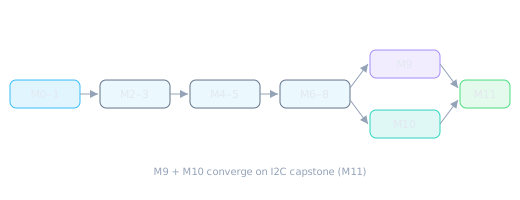
Do not jump to M11 without M4–8 RTL skills and M9–10 quality/verify habits.
Suggested pacing
| Pace | Hours/week | Finish in | Best for |
|---|---|---|---|
| Steady | 5–7 h | ~4–5 months | Students, career switchers with day jobs |
| Focused | 10–12 h | ~2–3 months | Interview deadline, internship prep |
| Light | 2–3 h | ~8+ months | Exploring alongside other courses |
- Module 0–1: 1 week — orientation + flow map
- Modules 2–5: 4–6 weeks — core Verilog muscle
- Modules 6–8: 3–4 weeks — FSMs and datapath
- Modules 9–10: 2–3 weeks — quality + verify (do not rush)
- Module 11: 2–4 weeks — I2C capstone sprint
Where this sits vs other EcrioniX courses
- This course — become an RTL designer end-to-end (general skills + I2C project).
- CDC Premium — deep specialization when Module 9 is not enough; we will link out when multi-clock topics go deep.
- Verilog Challenges — bite-sized graded practice (when available) to sharpen syntax and logic.
Do not skip Module 1 even if you “just want Verilog.” Knowing where RTL sits in Spec → PD prevents years of confused learning.
Capstone preview (I2C) — how modules tie back
Module 11 is not a toy counter. Every earlier module feeds it:
| Capstone piece | Built from modules |
|---|---|
| I2C spec + block diagram | M1 (spec), M1 arch lessons |
| Bit/byte FSM engines | M6–7 FSM + datapath |
| CSR register file | M4–5 sequential logic |
| Clock-domain notes (if APB vs core) | M9 CDC |
| Directed + corner tests | M10 verification |
| Lint/CDC/timing checklist | M9 + Lesson 0.3 review lens |
| Sim waves for demo | M0–2 simulator habits |
- Learn I2C basics (start/stop, ACK/NACK, addressing).
- Write a one-page spec and block diagram.
- Implement byte + bit engines with a small CSR map.
- Verify in the online simulator.
- Fill a lint/CDC/timing/area review checklist.
The capstone is proof you can integrate skills — exactly what interviewers ask for.
Everything before Module 11 is training for that project.
Your next action
- Bookmark the Verilog simulator
- Return to the course index
- Start Module 1.1 when it is published — Complete VLSI Flow
🎯 What to remember
- Flow first, then deep design, then quality, then I2C proof.
- Module 9 is a core selling skill set — treat it as seriously as coding.
- Module 0 is complete — you are ready for the VLSI map.