DFT — scan, ATPG, BIST (hooks designers must leave)
Factories cannot open every chip and probe millions of nodes. Design-for-Test (DFT) adds structures so manufacturing can detect defects. RTL designers must not accidentally destroy those hooks.
Why DFT exists
Manufacturing defects happen (shorts, opens, stuck transistors). DFT answers: “Can we tell good die from bad die cheaply?”
You cannot dismantle every suitcase. You design bags and scanners so problems are detectable quickly. DFT is the scanner-friendly suitcase design.
Controllability and observability
- Controllability: Can test logic force internal nodes to 0/1? Scan makes flops controllable.
- Observability: Can test logic see the result? Scan shifts values out to SO pin.
- Deep combo clouds between flops are harder to control/observe — ATPG may give low coverage.
Why it matters: A chip with 40% scan coverage may ship — but factory scrap rate and debug cost explode.
Scan (the big idea)
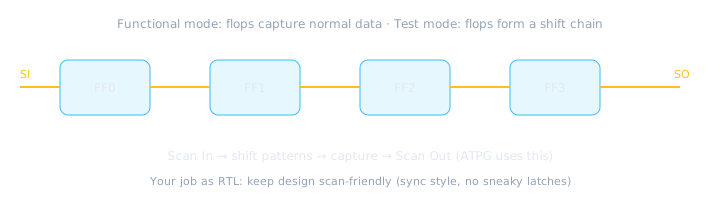
Scan stitches flops into a shift register during manufacturing test.
- Flops can be stitched into scan chains in test mode.
- Testers shift in patterns, pulse clocks, shift out results.
- ATPG tools generate those patterns automatically.
You may not write scan RTL by hand early on — but your coding style (async resets, clock enables, latches) affects how easily scan can be inserted.
Scan vs functional test
| Mode | What it tests | Who runs it |
|---|---|---|
| Functional (mission mode) | Real use cases, software paths | Board test, system DV |
| Scan (structural) | Stuck-at faults on internal nodes | ATE + ATPG patterns at factory |
| Memory BIST | SRAM bit cells, address decode | On-chip engine + minimal pins |
ATPG vocabulary
| Term | Plain English |
|---|---|
| Stuck-at-0 / stuck-at-1 | A node frozen — classic manufacturing defect model |
| Pattern | Bit sequence shifted into scan chains |
| Fault coverage % | Fraction of modeled faults detected |
| Scan enable (SE) | Flips flops into shift mode |
| Capture cycle | One functional clock edge while in test mode |
You rarely hand-code full scan, but you do respect a test-mode mux idea like this:
// Conceptual — DFT tools usually insert this automatically
module scan_mux_idea (
  input  wire func_d,   // normal functional data
  input  wire scan_si,  // scan chain input
  input  wire scan_en,  // 1 = test/shift mode
  output wire d_to_flop
);
  assign d_to_flop = scan_en ? scan_si : func_d;
endmodule

// RTL habit that helps DFT:
// - Prefer sync resets / clear clock enables
// - Avoid unintentional latches and combo loops
// - Document every clock and async set/reset
RTL that breaks DFT — bad vs good
// BAD: incomplete case → latch inferred → scan insertion pain
always @(*) begin
  if (sel) out = a;
  // missing else — latch holds previous value
end
// GOOD: full assignment every time — maps to mux, scan-friendly
always @(*) begin
  if (sel) out = a;
  else     out = b;
end
Gating clocks with random combo logic “to save power” without DFT review — scan chains break and ATPG coverage tanks.
BIST (built-in self-test)
Some blocks (memories especially) include on-chip pattern generators/checkers so external testers do less work.
Awareness level: if architecture says “memory BIST,” leave the interfaces and don’t “optimize away” test ports casually.
Memory BIST typically adds: BIST clock, start/done handshake, repair fuse hooks for redundant rows. RTL designer keeps the wrapper ports visible — DFT fills the engine.
“How does scan help manufacturing?” — Shifts test patterns through flops to detect stuck faults that functional boot tests would miss.
What RTL designers should remember
- Prefer synchronous design styles that DFT tools like
- Don’t invent sneaky latches or combo loops
- Respect test-mode signals and lockup-latch guidance from DFT team
- Document clocks/resets clearly — DFT depends on that map
You are not becoming a DFT engineer today. You are learning why “just combo hacks” create expensive DFT pain later.
DFT vocabulary quick reference
| Acronym | Meaning |
|---|---|
| DFT | Design for test |
| ATPG | Automatic test pattern generation |
| ATE | Automated test equipment (factory tester) |
| MBIST | Memory built-in self-test |
| SI / SO | Scan in / scan out chain pins |
🎯 What to remember
- DFT makes manufacturing test possible at scale.
- Scan + ATPG and BIST are the common vocabulary.
- Clean, sync-friendly RTL is DFT-friendly RTL.
- Next: synthesis — turning RTL into gates.