Functional Verification — why design without verify is incomplete
Silicon bugs are expensive. Functional verification asks: does the RTL do what the spec says? Designers who “throw RTL over the wall” create schedule fires. You will learn to verify as you design.
Verification in one picture
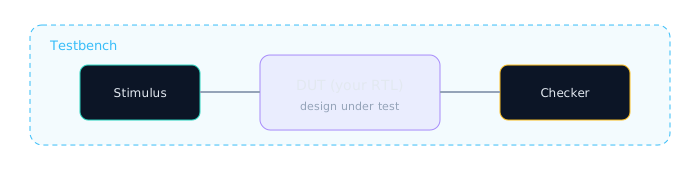
Verification = drive inputs + check outputs. Exit code 0 without checks proves almost nothing.
- Build a testbench that drives inputs and checks outputs.
- Run many scenarios (happy path + corners).
- Debug mismatches with waveforms.
- Measure how much of the design you stimulated (coverage — later depth).
- Sign that known risks are listed, not ignored.
In this course, Module 10 goes deeper. Here you only need the why and the designer’s duty.
Testbench anatomy — four layers
| Layer | Job | I2C example |
|---|---|---|
| Clock / reset generator | Legal power-on | Release rst_n after 100 ns |
| Stimulus driver | Drive inputs per test | Write CSR START, load ADDR/TXDATA |
| DUT instance | Your RTL | i2c_master |
| Checker / scoreboard | Compare vs expected | BUSY clears; NACK sticky on slave NACK |
Designer vs verification engineer
RTL designer
Owns block intent, unit tests, lint cleanliness, review readiness.
Verification
Owns system scenarios, constrained-random, coverage closure, bug hunting at scale.
On small teams (and in this course), you wear both hats for your blocks.
Directed vs random (intro)
- Directed tests: Human writes exact stimulus — great for bring-up and spec acceptance (A1, A2).
- Constrained-random: Tool randomizes within rules — finds corner combos humans forget.
- Regression: Re-run all tests on every RTL change — catches “fixed one bug, broke another.”
Bug lifecycle
Every closed bug should add a non-regression test — otherwise it will come back.
What “tested” means (beginner bar)
- Reset behavior checked
- At least one full legal transaction checked
- At least one illegal / NACK / abort path thought about
- Waveform inspected — not only “exit code 0”
Trap: a testbench that only prints “Hello” proves nothing about your DUT.
Coverage intuition
Coverage answers: “Did we exercise enough of the design?” Not a substitute for correct checks — but catches untested code paths.
- Line / code coverage: Which RTL lines ran?
- FSM state coverage: Did we visit IDLE, XFER, ERROR?
- Functional coverage: Did we see NACK + abort + back-to-back writes?
Assertion lite (SVA preview)
// Property: BUSY must be 0 in reset
// In full SystemVerilog:
// assert property (@(posedge clk) disable iff (!rst_n) !busy);

// Verilog-style check in TB:
always @(posedge clk) begin
  if (!rst_n && busy)
    $display("FAIL: busy high during reset");
end
Self-checking starter (DUT + TB). Paste both into the simulator:
module add1 (
  input  wire [3:0] a,
  input  wire [3:0] b,
  output wire [4:0] sum
);
  assign sum = a + b;
endmodule
module tb_add1;
  reg  [3:0] a, b;
  wire [4:0] sum;
  integer errors;

  add1 dut (.a(a), .b(b), .sum(sum));

  initial begin
    errors = 0;
    a = 4'd3; b = 4'd5; #1;
    if (sum !== 5'd8) begin $display("FAIL 3+5"); errors = errors + 1; end

    a = 4'd15; b = 4'd1; #1;
    if (sum !== 5'd16) begin $display("FAIL 15+1"); errors = errors + 1; end

    if (errors == 0) $display("PASS");
    else $display("FAILED %0d", errors);
    $finish;
  end
endmodule
Corner case lab — overflow
Add a third test: maximum values can expose width bugs.
    // Corner: 15 + 15 = 30 (fits 5-bit sum)
    a = 4'd15; b = 4'd15; #1;
    if (sum !== 5'd30) begin
      $display("FAIL 15+15 got %0d", sum);
      errors = errors + 1;
    end

    // Corner: 15 + 1 = 16 (carry into bit 4)
    a = 4'd15; b = 4'd1; #1;
    if (sum !== 5'd16) begin
      $display("FAIL carry case");
      errors = errors + 1;
    end
“How do you verify an FSM?” — Directed tests per state transition + illegal input + reset during BUSY + coverage on states.
How we practice here
Every coding lesson should end in the simulator with a check — even a simple self-checking comparison.
Verification is not decoration. It is the seatbelt. You hope you never need the crash — you still buckle up every trip.
Verification vocabulary
| Term | Meaning |
|---|---|
| DUT | Design under test — your RTL |
| TB | Testbench — stimulus + checks |
| Scoreboard | Golden model comparing expected vs actual |
| Regression | Re-run all tests after each change |
| Waived bug | Known issue accepted with sign-off |
🎯 What to remember
- Unverified RTL is a draft, not a deliverable.
- Designers own unit-level proof; verification scales system risk.
- Minimum bar: reset + legal path + one corner + waves.
- Next: DFT — manufacturing test hooks designers must leave.