Synthesis — RTL → gates (what the tool actually does)
Synthesis translates your RTL into a gate-level netlist using a cell library (AND/OR/flop cells for a technology node). It is not “compiling software” — it explores hardware implementations under constraints.
Inputs and outputs
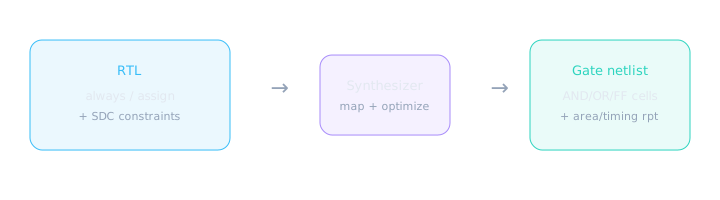
Synthesis is a constrained hardware translation — not a software compile.
- In: RTL + timing constraints (clocks, IO delays) + library + sometimes DFT requirements
- Out: netlist + reports (area, timing estimates) + sometimes mapped scan
In learning mode you may use open tools (e.g. Yosys concepts). In industry: Design Compiler, Genus, etc. The ideas match.
Constraints intro — defining clocks (SDC)
# Tell synthesis the clock exists and its period
create_clock -name clk_sys -period 10.0 [get_ports clk]

# Input delay: data arrives 2ns after clock edge (example)
set_input_delay  2.0 -clock clk_sys [get_ports csr_wdata*]
set_output_delay 2.0 -clock clk_sys [get_ports csr_rdata*]

# False paths / multicycle exceptions added later with care
Without create_clock, the tool does not know how fast to optimize — timing reports are meaningless.
Technology library idea
Synthesis maps RTL to standard cells from a foundry library (e.g. 7nm, 28nm). Each cell has area, delay, and power characteristics. You do not pick individual AND gates in RTL — the tool chooses from the library under constraints.
What the tool tries to optimize
Timing
Meet setup (and later hold via other steps) for target clocks.
Area
Prefer smaller implementations when timing allows.
Power
Clock gating and cell choices (depth grows later).
QoR levers (quality of results)
| Lever | RTL / constraint action |
|---|---|
| Pipeline | Break long combo paths with registers |
| Retiming | Tool moves logic across flops (advanced) |
| Resource sharing | One multiplier time-multiplexed vs many |
| Clock gating | Stop toggling idle flops |
| Constraint tightness | 10 ns period vs 8 ns — harder but faster chip |
When timing fails, ask: “Is it RTL structure, missing pipeline, wrong constraint, or placement?” — blame category before blame person.
Why your coding style matters (QoR)
- Huge priority logic / unbalanced paths → tough timing.
- Accidental latches → unexpected behavior and DFT pain.
- Asynchronous spaghetti → tools and humans suffer.
- Clear FSMs and registered outputs → happier reports.
Synthesis is a translator. If your sentences are ambiguous, the translation will be weird — and you will blame the translator incorrectly.
Same function, two coding styles. The left is clear RTL; synthesis may map both to similar gates — but messy priority clouds hurt QoR:
// Clean, obvious mux — synthesizer-friendly
module mux2_clean (
  input  wire [7:0] a,
  input  wire [7:0] b,
  input  wire       sel,
  output wire [7:0] y
);
  assign y = sel ? b : a;
endmodule
// Still legal — but a long priority chain can hurt timing
module priority_cloud (
  input  wire [7:0] req,
  output reg  [2:0] grant_id,
  output reg        grant_valid
);
  always @(*) begin
    grant_valid = 1'b0;
    grant_id    = 3'd0;
    if      (req[0]) begin grant_valid = 1'b1; grant_id = 3'd0; end
    else if (req[1]) begin grant_valid = 1'b1; grant_id = 3'd1; end
    else if (req[2]) begin grant_valid = 1'b1; grant_id = 3'd2; end
    else if (req[3]) begin grant_valid = 1'b1; grant_id = 3'd3; end
    // ... imagine this continuing for dozens of sources
  end
endmodule
Latch inference — bad vs full case
always @(*) begin
  if (en) q = d;  // else branch missing → latch
end
always @(*) begin
  if (en) q = d;
  else    q = 1'b0;  // full case → mux, not latch
end
Area vs timing tradeoff
Pipelining adds flops (area ↑) but shortens combo paths (timing ↑). A 32-bit adder in one cycle may fail at 500 MHz; two pipelined stages often pass. Synthesis alone cannot always fix a bad micro-architecture.
“What is QoR?” — Quality of Results: how well synthesis met timing, area, and power goals for the constraints given.
Designer habit
- Write RTL as if a synthesizer is reading over your shoulder
- Keep a mental “critical path” for big combo clouds
- Read reports later in Module 9 — today just respect that they exist
- Ask for synthesis trial run before claiming “timing will be fine”
Synthesis report vocabulary
| Report line | What it tells you |
|---|---|
| Total cell area | Silicon cost proxy |
| Worst negative slack (WNS) | How far from timing goal |
| Inferred latches | RTL bug — fix before PD |
| Unmapped logic | Constructs synthesis cannot handle |
🎯 What to remember
- Synthesis maps RTL to library gates under constraints.
- Timing, area, and power are competing goals.
- Clean RTL improves QoR; clever hacks often do not.
- Next: physical design — placing and routing the real die.