Moore vs Mealy — when each is right
Every control block is a finite state machine (FSM). The split that matters most in RTL is where outputs are computed: Moore machines drive outputs from state only; Mealy machines drive outputs from state plus current inputs. That one choice changes timing, area, and how you debug waveforms.
Moore: output = f(state). Registered, stable for the whole cycle in state.
Mealy: output = f(state, inputs). Can react combinationally to inputs within the same cycle.
Side-by-side — same traffic-light spec
Consider a simple controller: in IDLE wait for go; in GREEN assert light_green until timer_done; return to IDLE.
| Aspect | Moore | Mealy |
|---|---|---|
| Output source | Decoded from state only | Decoded from state + go, timer_done |
| Output timing | Changes only after state update (next posedge) | Can change same cycle as input (combo path) |
| Typical latency | +1 cycle vs minimal Mealy for same reaction | Can be 0-cycle reaction to inputs |
| State count | Often more states (output encoded in state) | Often fewer states (output on transitions) |
| Glitch risk | Lower if outputs registered from state | Higher if outputs are combo from inputs |
| Waveform debug | Outputs align cleanly with state bubbles | Outputs may pulse within a state |
Moore state diagram
Outputs live inside the state bubble. Transitions carry only input conditions — no output labels on arrows.
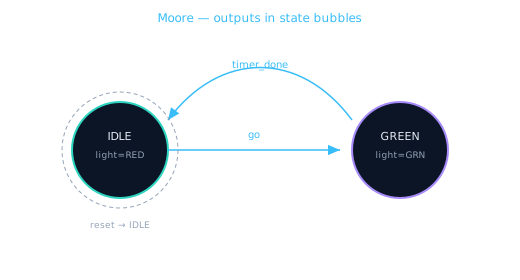
Moore: light_green is implied by being in GREEN — not written on the transition.
Mealy state diagram
Outputs can appear on transition arcs — the machine asserts a signal while a condition is true, even before the state register updates.
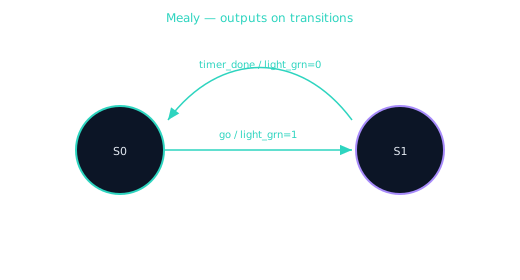
Mealy: output actions ride on the edge label input / output.
Timing — why Moore is one cycle slower
Industry default: Prefer Moore (or Moore-style registered outputs) for chip-wide control signals. Use Mealy only when you need same-cycle response and you register or qualify the output path carefully.
Moore RTL — output decode block
// Moore traffic controller — outputs from state only
module moore_traffic (
  input  wire       clk,
  input  wire       rst_n,
  input  wire       go,
  input  wire       timer_done,
  output wire       light_green,
  output wire       light_red
);
  localparam IDLE  = 2'd0;
  localparam GREEN = 2'd1;

  reg [1:0] state, next;

  always @(posedge clk or negedge rst_n)
    if (!rst_n) state <= IDLE;
    else        state <= next;

  always @(*) begin
    next = state;
    case (state)
      IDLE:  if (go)         next = GREEN;
      GREEN: if (timer_done) next = IDLE;
      default: next = IDLE;
    endcase
  end

  // Moore outputs — function of state ONLY
  assign light_green = (state == GREEN);
  assign light_red   = (state == IDLE);
endmodule
Mealy RTL — output in next-state logic
// Mealy traffic controller — output from state + inputs
module mealy_traffic (
  input  wire       clk,
  input  wire       rst_n,
  input  wire       go,
  input  wire       timer_done,
  output reg        light_green
);
  localparam S0 = 1'b0;
  localparam S1 = 1'b1;

  reg state, next;

  always @(posedge clk or negedge rst_n)
    if (!rst_n) state <= S0;
    else        state <= next;

  always @(*) begin
    next        = state;
    light_green = 1'b0;          // default
    case (state)
      S0: begin
        if (go) begin
          next        = S1;
          light_green = 1'b1;      // Mealy: assert on transition condition
        end
      end
      S1: begin
        light_green = 1'b1;        // hold while in S1
        if (timer_done) next = S0;
      end
      default: next = S0;
    endcase
  end
endmodule
Mealy outputs in always @(*) can glitch when inputs glitch. For external pins or long combo paths, register the output (always @(posedge clk)) — you get a "Moore-ish" timing profile with cleaner timing closure.
Decision guide — when to use each
Pick Moore when…
Outputs must be stable all cycle; easy waveform review; multi-clock or CDC output registers; protocol outputs sampled on clock edge.
Pick Mealy when…
You need minimum latency; fewer states matter (area in state reg); output is inherently tied to input condition (e.g. ack = req & ready).
Hybrid (common)
Mealy next-state + Moore registered outputs: compute next_out combo, register to out. Best of debuggability and timing control.
FSM type checklist
- Draw the state diagram before coding — label Moore outputs in bubbles, Mealy on arcs
- Document whether each output is Moore, Mealy, or registered Mealy
- Moore: separate
next_stateandoutput_decodeblocks - Mealy: default every output in the combo block; watch for inferred latches
- Check latency: does the spec need same-cycle or next-cycle response?
- Run waves: do outputs glitch mid-cycle on input edges?
🎯 What to remember
- Moore: output = f(state) — stable, +1 cycle latency, easier debug.
- Mealy: output = f(state, input) — faster reaction, fewer states, glitch risk.
- Most production RTL uses Moore outputs or registered Mealy outputs.
- Always draw the diagram first — the Moore/Mealy choice should be explicit.