Reading a lint report and fixing root causes
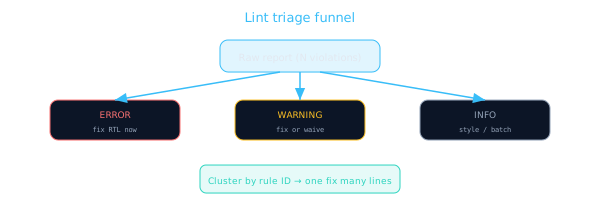
A lint report is a structured bug list. The skill is not clicking "waive all" — it is triage by severity, cluster by rule, and fix the RTL pattern that caused a dozen related violations.
Change the RTL so the violation class disappears everywhere — not just silence one line with a pragma while the same pattern repeats in 40 modules.
Anatomy of a lint report line
Every violation has the same skeleton. Learn to read it once and you can triage any tool — SpyGlass, VC SpyGlass, Verilator -Wall, or your CI dashboard.
| Field | Meaning | Action |
|---|---|---|
| Severity | ERROR / WARNING / INFO | ERROR blocks merge; WARNING needs fix or waiver |
| Rule ID | e.g. INFERRED_LATCH | Look up in rule deck; cluster fixes |
| File:line | Exact location | Jump there — but check pattern elsewhere |
| Message | Human-readable why | Maps to fix pattern from 9.1–9.3 |
Sample violations — read and fix
// This file generates 4 lint violations — find and fix each
module violation_source (
  input  wire       clk, clk_uart,
  input  wire       rst_n,
  input  wire       en,
  input  wire [7:0] data,
  input  wire       tx_done,
  output reg  [7:0] out,
  output reg        irq
);
  // V1: INFERRED_LATCH — line 15
  always @(*) begin
    if (en) out = data;
  end

  // V2: GATED_CLOCK — line 20
  wire gclk = clk & en;
  reg [3:0] cnt;
  always @(posedge gclk) cnt <= cnt + 1;

  // V3: CDC_NO_SYNC — line 26
  always @(posedge clk)
    irq <= tx_done;  // tx_done from clk_uart domain

  // V4: MULTIPLE_DRIVER — line 30 (if assign added below)
endmodule
// assign out = 8'hFF;  // uncomment → MULTIPLE_DRIVER
// Root-cause fixes for all four violation classes
module violation_fixed (
  input  wire       clk, clk_uart,
  input  wire       rst_n,
  input  wire       en,
  input  wire [7:0] data,
  input  wire       tx_done,
  output reg  [7:0] out,
  output reg        irq
);
  // Fix V1: default assignment
  always @(*) begin
    out = 8'h00;
    if (en) out = data;
  end

  // Fix V2: enable flop, not gated clock
  reg [3:0] cnt;
  always @(posedge clk) begin
    if (!rst_n) cnt <= 0;
    else if (en) cnt <= cnt + 1;
  end

  // Fix V3: 2-flop synchronizer for CDC
  reg tx_done_meta, tx_done_sync;
  always @(posedge clk or negedge rst_n) begin
    if (!rst_n) {tx_done_meta, tx_done_sync} <= 2'b00;
    else        {tx_done_meta, tx_done_sync} <= {tx_done, tx_done_meta};
  end
  always @(posedge clk)
  irq <= tx_done_sync;
endmodule
Severity policy — when to fix vs waive
| Severity | Typical policy | Waiver acceptable when… |
|---|---|---|
| ERROR | Zero at merge | Almost never — fix RTL |
| WARNING | Fix or approved waiver | Third-party encrypted IP, documented false positive |
| INFO | Team discretion | Style rules with agreed exceptions |
Waiving without a root-cause note creates audit debt. Six months later nobody knows if the waiver hid a real CDC bug or a style nit. Every waiver needs: rule ID, justification, owner, expiry date.
Clustering — one fix, many violations
A report with 200 INFERRED_LATCH warnings often means one coding habit, not 200 unique bugs. Fix the macro pattern:
- Sort report by rule ID — count occurrences
- Pick the top rule — usually latch, CDC, or clock
- Find the shared anti-pattern (missing default, no sync, gated clk)
- Apply team coding template — re-run lint
- Repeat until ERROR count is zero
Pro workflow: Export lint to CSV, pivot by rule ID and module. Present "top 5 rule clusters" in review instead of scrolling 10,000 lines.
False positives — verify before waiving
Some violations are tool limitations, not real bugs. Before waiving, confirm:
- The signal is actually in the domain the tool claims
- Encrypted IP black-boxes aren't generating phantom crossings
- Your SDC/UPF matches the RTL clock names
- Generated RTL (FIFO wrappers) has lint waivers in the generator, not hand-edited
- Simulation and formal agree the path is safe (for CDC waivers)
# Waiver record — required fields
Rule:       CDC_NO_SYNC
Module:     third_party_phy_wrap
Line:       0 (encrypted)
Severity:   WARNING
Owner:      jsmith
Date:       2026-03-15
Expiry:     2027-03-15  (annual review)
Justification: Encrypted PHY IP; vendor signoff doc #PHY-CDC-042
              confirms internal 2FF sync. Our lint cannot see inside.
Action:     None — IP-level waiver in waiver.tcl
Re-verify:  Re-run after PHY IP version bump
CI integration — lint as a merge gate
Production flows wire lint into CI with a pass/fail threshold. Your job as a designer is to keep the local run green before pushing.
#!/bin/bash
# Typical block-level lint CI step
sg_shell -tcl lint_block.tcl | tee lint.rpt
ERROR_COUNT=$(grep -c "Severity: Error" lint.rpt)
WARN_COUNT=$(grep -c "Severity: Warning" lint.rpt)
echo "Errors: $ERROR_COUNT  Warnings: $WARN_COUNT"
if [ "$ERROR_COUNT" -gt 0 ]; then
  echo "LINT FAILED — fix ERRORs before merge"
  exit 1
fi
# Warnings over threshold also fail in strict teams
if [ "$WARN_COUNT" -gt 50 ]; then
  echo "WARNING budget exceeded — triage before merge"
  exit 1
fi
echo "LINT PASSED"
| CI stage | Runtime | Rules enabled |
|---|---|---|
| Pre-commit (local) | < 2 min | Latch, multi-drive, basic clock |
| PR check | 5–15 min | Full block deck |
| Nightly SoC | 1–4 hrs | CDC, RDC, full chip |
From lint clean to CDC mindset
Clock/reset and CDC rules dominate signoff reports on SoCs. Lessons 9.5–9.6 shift from "fix the warning" to "design domains correctly." For the full CDC methodology, see the CDC deep-dive course.
🎯 What to remember
- Read severity → rule ID → location → message. Cluster by rule, not by line.
- ERROR = fix RTL. WARNING = fix or documented waiver. INFO = team policy.
- One anti-pattern often causes dozens of violations — fix the pattern.
- Waivers need owner, justification, and expiry — not "waive all."
- Next: why multi-clock SoCs exist and why CDC is a designer concern.