Specification — writing requirements design can implement
Bad specs create endless RTL thrash. A good spec is not a novel — it is a contract: what the design must do, how fast, on which pins, and how you will know it is done.
What belongs in a useful spec
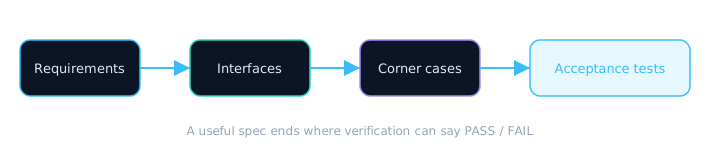
Spec quality = how clearly you can turn MUST lines into tests.
- Purpose — one paragraph: who uses this IP and why.
- Features — numbered list of behaviors (must / should / nice-to-have).
- Interfaces — clocks, resets, buses, protocols (e.g. I2C pins, IRQ).
- Performance — throughput, latency, max clock, timing modes.
- Power / modes — sleep, clock gating expectations (even if light).
- Error / corner cases — NACK, clock stretch, illegal commands.
- Acceptance tests — how verification will prove success.
Trap: “Make it work like the competitor chip” with zero numbers. That is not a spec — it is a wish.
SMART requirements (make every MUST testable)
| Letter | Means | Spec example (I2C) |
|---|---|---|
| Specific | One behavior per line | M3: Detect ACK/NACK after each byte |
| Measurable | Numbers or observable signals | M1: Standard-mode 100 kHz SCL target |
| Achievable | Feasible at target node / clock | No “1 GHz I2C” on a 50 MHz sysclk without justification |
| Relevant | Tied to product need | Sensor read — not “add UART because cool” |
| Time-bound | Version / milestone | v1: write-only; v2: clock stretch |
Ambiguity workshop — bad vs good MUST lines
| ❌ Vague (fights later) | ✅ Testable (design can implement) |
|---|---|
| “Fast I2C” | MUST meet I2C standard-mode bit timing with SCL period ≥ 10 µs |
| “Handle errors gracefully” | MUST set sticky NACK bit and deassert BUSY within 1 byte time on slave NACK |
| “Low power” | SHOULD gate clk_sys to bit engine when STAT.BUSY=0 |
| “Support all addresses” | MUST support 7-bit addressing; 10-bit is MAY for v2 |
Words like robust, seamless, and user-friendly belong in marketing slides — not in MUST lines. Replace each with a signal, timing number, or pass/fail test.
Requirements language that prevents fights
MUST
Non-negotiable. Missing it is a bug.
SHOULD
Strong preference; skip only with written reason.
MAY
Optional. Nice for v2.
Example: “The I2C master MUST generate START/STOP per Spec Rev 1. The UI MAY expose a debug counter.”
Performance and power wording
- Throughput: “MUST sustain 1 byte per 90 µs at 100 kHz SCL” — not “fast enough.”
- Latency: “MUST assert IRQ within 2 clk_sys cycles of DONE” — ties to software.
- Clock: “MUST operate with clk_sys 25–100 MHz” — gives synthesis/PD bounds.
- Power modes: “SHOULD allow clock gate when idle; MUST retain CSR on reset deassert.”
Change control (specs are living documents)
Requirements change — the failure mode is silent change. Good teams use:
- Version number on every spec (v1.2, date, author)
- Change log: what changed, why, who approved
- Impact line: “M4 added → RTL + 2 new directed tests”
- Re-baseline acceptance tests when MUST lines change
When PM adds a feature mid-sprint, ask: “Is this a new MUST? Which acceptance test proves it?” That one question saves weeks of argument.
Spec → RTL: the handoff question
Before coding, a designer should answer:
- What are the inputs/outputs and their reset values?
- What clocks/domains exist?
- What sequences are legal vs illegal?
- What does “pass” look like in simulation?
A menu that says “tasty food” cannot be cooked consistently. A menu that lists ingredients, sizes, and allergens can. Specs are menus for silicon.
Interface checklist (every external port)
- Name, direction, width, active-high/low
- Clock domain and reset value at deassert
- Protocol timing (setup/hold if relevant)
- Legal sequences vs illegal (what happens on illegal?)
- Electrical type (open-drain for I2C SCL/SDA)
- Back-pressure or flow control (valid/ready?)
Acceptance criteria template
ACCEPTANCE TEST ID: A#
TITLE: <one-line behavior>
PRECONDITION: <reset state, clocks, config registers>
STIMULUS: <step-by-step transactions>
EXPECTED: <signals / CSR bits / timing>
PASS CRITERIA: <automatable check — not "looks good">
OWNER: DV / designer
MUST REF: M#
Mini exercise (I2C foreshadow)
Write 5 MUST lines for an I2C master (even if rough). Example starter:
- MUST support 7-bit addressing
- MUST detect ACK/NACK after each byte
- MUST allow software to abort a hung transfer
Keep this list — Module 11 will turn it into a real one-page spec.
Here is how a real (tiny) I2C master micro-spec might start — copy this style into your notes:
IP: i2c_master_v1
PURPOSE: Let software read/write I2C sensors on the board.

MUST:
  M1. Support 7-bit addressing, standard-mode (100 kHz target)
  M2. Generate START, STOP, repeated-START per I2C timing rules
  M3. Detect ACK/NACK after every address and data byte
  M4. Expose BUSY and NACK sticky status bits in CSR
  M5. Allow software abort of a hung transfer (ABORT bit)

SHOULD:
  S1. Support clock stretching from slave
  S2. Interrupt on DONE / NACK

MAY:
  X1. Debug byte counter (v2)

ACCEPTANCE:
  A1. Directed TB: START -> addr+W -> data -> STOP, ACK path PASS
  A2. Directed TB: slave NACK sets sticky NACK, clears BUSY
  A3. Abort during BUSY returns FSM to IDLE within 1 byte time
Worked example — clock stretch corner (SHOULD line becomes a test):
S1. SHOULD support clock stretching from slave

ACCEPTANCE A4 (stretch):
  PRE: Master in byte transfer, SCL released high
  STIM: Slave holds SCL low for 50 µs then releases
  EXPECT: Master waits (no premature STOP); BUSY remains 1;
          transfer completes after release
  PASS: TB measures SCL low time; FSM does not timeout before S1 limit
“How do you know when RTL is done?” — Point to acceptance tests tied to MUST lines, not “simulation passed once.” Done = spec contract satisfied with evidence.
Why specification matters (downstream cost)
| Spec quality | Typical downstream cost |
|---|---|
| Clear MUST + acceptance | One RTL pass, predictable schedule |
| Vague features | 3+ RTL rewrites, blame games |
| Missing corner cases | Silicon bug + firmware workaround |
| No change control | “Surprise” features break ABI |
MUST M8: Read transaction MUST issue repeated-START after address byte (R/W=1)
MUST M9: RXDATA valid only when STAT.DONE=1 and STAT.NACK=0

ACCEPTANCE A6:
  PRE: Slave model returns 0x42 on read
  STIM: Write addr+W, repeated-START, addr+R, read byte, STOP
      EXPECT: RXDATA=0x42, DONE=1
🎯 What to remember
- A spec is a contract: features, interfaces, performance, corners, acceptance.
- Use MUST/SHOULD/MAY to avoid ambiguous fights.
- If you cannot test it, you cannot claim it.
- Next: architecture — blocks, interfaces, clocks, power domains.