Sync vs async reset — industry choice & why
Reset is not an afterthought — it's a team-wide convention that affects timing closure, DFT scan insertion, CDC, and whether your chip boots reliably. This lesson compares asynchronous and synchronous reset in depth so you can read any company's style guide and know why they chose what they chose.
Async reset can clear flops immediately, independent of clock — but deassertion must be synchronized. Sync reset clears only on a clock edge — simpler timing, but reset must be held until the next clock.
Side-by-side comparison
| Aspect | Asynchronous reset | Synchronous reset |
|---|---|---|
| Assert timing | Immediate — no clock needed | Next posedge clk after rst asserted |
| Deassert timing | Must sync — recovery/removal risk | Clean — deasserts on clock edge |
| Sensitivity list | posedge clk or negedge rst_n | posedge clk only |
| STA constraints | Recovery & removal checks on rst | Reset is just another sync input |
| DFT / scan | Scan chains need async reset handling | Easier scan insertion — reset is sync |
| Power-on | Chip enters known state before first clock | Flops may be X until first clocked reset |
| Industry trend | Assert async, deassert sync (hybrid) | Pure sync in many FPGA flows |
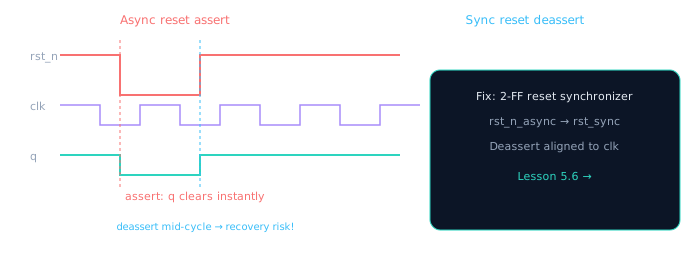
Async assert is safe; async deassert near a clock edge causes recovery/removal metastability.
Async reset is an emergency stop button — works even if the conveyor (clock) is off. Sync reset is a scheduled shutdown — only takes effect when the conveyor reaches the marked stop point. You want the emergency stop to work instantly, but you want the "all clear" signal to arrive on a schedule.
RTL templates — same polarity, different lists
// Async assert, async deassert (needs synchronizer at chip level!)
always @(posedge clk or negedge rst_n) begin
  if (!rst_n)
    state <= IDLE;
  else
    state <= next_state;
end
// Pure synchronous reset — rst_n is just another input
always @(posedge clk) begin
  if (!rst_n)
    state <= IDLE;
  else
    state <= next_state;
end
Mixing async and sync reset styles in the same design without documentation causes STA failures and simulation/synthesis mismatches. Follow the project style guide — one convention per chip.
DFT implications
Scan test chains shift test data through every flip-flop. Reset behavior during scan mode matters:
- Async reset on scan FFs: Must be controllable in test mode — often gated or overridden by
scan_reset - Sync reset: Scan insertion tools handle it cleanly — reset is applied synchronously during capture
- Reset tree: Large designs buffer reset through a tree; async trees have skew that sync deassert must account for
Leave a test_mode or scan_en signal that can override reset polarity during ATPG. DFT engineers will ask for this in review — design it in from the start.
Timing: recovery & removal
STA checks two reset-specific margins:
| Check | What it means | Fails when |
|---|---|---|
| Recovery | Reset deasserts far enough before clock edge | rst_n rises too close to posedge clk |
| Removal | Reset deasserts far enough after clock edge | rst_n rises too soon after posedge clk |
Why sync deassert wins: A reset synchronizer (Lesson 5.6) guarantees deassertion happens away from the clock edge, eliminating recovery/removal violations chip-wide.
Team conventions — what you'll see in industry
| Convention | Who uses it | Rationale |
|---|---|---|
| Async assert / sync deassert | Most ASIC teams | Fast boot + clean timing |
| Pure sync reset | Many FPGA projects | Simpler tools, BRAM-friendly |
Active-high rst | Some legacy IP | Match polarity in wrapper — don't fight it |
| Power-on reset (POR) + soft reset | Mobile SoCs | POR handles power-up; software triggers sync soft reset |
Interview tip: When asked "async or sync reset?" — answer "async assert, sync deassert with a reset synchronizer" and explain recovery/removal. That shows production awareness.
Reset strategy checklist
- Know your project's reset polarity (
rst_nvsrst) and stick to it - Never async-deassert reset into logic without a synchronizer
- Document which blocks use async vs sync reset in the micro-arch spec
- Verify reset values of every register — don't leave FSMs in illegal states
- Include reset in your self-checking testbench (Lesson 5.7)
- Check DFT requirements before taping out scan chains
🎯 What to remember
- Async reset asserts immediately; deassertion is the danger zone for timing.
- Sync reset simplifies STA and DFT but needs a clock to take effect.
- Industry default: async assert + sync deassert via reset synchronizer.
- One reset convention per chip — document it and lint against violations.