Self-checking testbench + waveform bring-up
RTL without a testbench is a guess. This lesson gives you a complete self-checking environment for the 11.4 RTL: clock/reset, open-drain bus wiring, a behavioral I2C slave BFM, and PASS/FAIL checks for write-with-ACK, NACK, and abort. Plus a waveform guide so you can debug when checks fail.
Run three directed tests without touching waveforms. If all pass, your byte FSM, bit engine, and CSR handshake are correct. Waveforms are for debug — not your primary pass criteria.
Testbench structure
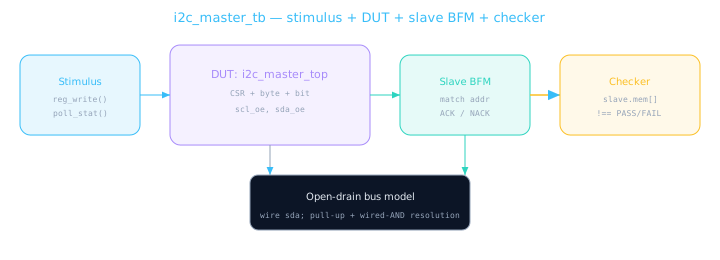
The slave BFM is behavioral (not synthesizable). It watches SCL/SDA and responds on the bus.
| Block | Role | Key signals |
|---|---|---|
| Clock/reset | 100 MHz sys_clk, active-low rst_n | clk, rst_n |
| Bus resolver | Wired-AND open-drain on SDA/SCL | sda, scl wires |
| Reg tasks | Drive CSR like software would | reg_write(addr, data) |
| Slave BFM | Decode addr, ACK/NACK, capture data | slave_mem[0] |
| Checker | Compare slave memory vs expected | errors, tests_run |
Open-drain bus model
Both master and slave drive low or release. The TB models pull-ups and resolves multiple drivers with wired-AND logic.
// Open-drain bus resolution — instantiate in TB
module i2c_bus_wire (
  input  wire m_sda_out, m_sda_oe,
  input  wire s_sda_out, s_sda_oe,
  output wire sda
);
  // Wired-AND: line is low if ANY driver pulls low with oe active
  assign sda = (m_sda_oe && !m_sda_out) ? 1'b0 :
               (s_sda_oe && !s_sda_out) ? 1'b0 : 1'b1; // pull-up
endmodule

// SCL same pattern (slave typically doesn't drive SCL in this lab)
module i2c_scl_wire (
  input  wire m_scl_out, m_scl_oe,
  output wire scl
);
  assign scl = (m_scl_oe && !m_scl_out) ? 1'b0 : 1'b1;
endmodule
If you forget the pull-up model, sda_i floats to X and ACK sampling fails randomly. Always resolve the bus before connecting to sda_i.
Behavioral I2C slave BFM
A minimal slave: watches for START, shifts in 8 bits, compares address, drives ACK (pull SDA low) or releases for NACK, captures data byte on match.
// i2c_slave_bfm.v — behavioral slave (simulation only)
module i2c_slave_bfm (
  input  wire       scl,
  inout  wire       sda,
  input  wire [6:0] slave_addr,   // 7-bit address
  input  wire       force_nack,   // test knob: always NACK
  output reg  [7:0] captured_data,
  output reg        got_write
);
  reg sda_out, sda_oe;
  assign sda = sda_oe ? sda_out : 1'bz;

  reg [3:0] bit_idx;
  reg [7:0] shift;
  reg       in_frame;
  reg       addr_match;
  reg       is_data_phase;

  always @(negedge scl or posedge scl) begin
    if (!scl) begin
      // Release SDA by default each low phase (except ACK drive)
      if (!(bit_idx == 4'd8 && addr_match && !force_nack))
        sda_oe <= 1'b0;
    end
  end

  always @(posedge scl) begin
    if (sda == 1'b0 && scl == 1'b1) begin // crude START detect
      in_frame <= 1'b1;
      bit_idx <= 4'd0;
      shift <= 8'h00;
      is_data_phase <= 1'b0;
      addr_match <= 1'b0;
      got_write <= 1'b0;
    end else if (in_frame) begin
      if (bit_idx < 8) begin
        shift <= {shift[6:0], sda};
        bit_idx <= bit_idx + 1'b1;
      end else if (bit_idx == 8) begin
        // ACK slot — slave drives
        if (!is_data_phase) begin
          if ({shift[7:1]} == slave_addr && shift[0] == 1'b0) begin
            addr_match <= 1'b1;
            if (!force_nack) begin
              sda_out <= 1'b0; sda_oe <= 1'b1; // ACK
            end
          end
          is_data_phase <= 1'b1;
        end else begin
          captured_data <= shift;
          got_write <= 1'b1;
          if (!force_nack) begin
            sda_out <= 1'b0; sda_oe <= 1'b1; // ACK data
          end
          in_frame <= 1'b0;
        end
        bit_idx <= 4'd0;
        shift <= 8'h00;
      end
    end
  end
endmodule
Note: This BFM is intentionally simple for teaching — it uses posedge SCL sampling, not a production bit-bang model. It is good enough to exercise your master's byte FSM.
CSR helper tasks + polling
// CSR offsets (match Lesson 11.4 / 11.2 map)
localparam OFF_CTRL   = 8'h00;
localparam OFF_STAT   = 8'h04;
localparam OFF_ADDR   = 8'h08;
localparam OFF_TXDATA = 8'h0C;
localparam OFF_CLKDIV = 8'h14;

reg        reg_wr, reg_rd;
reg [7:0]  reg_addr;
reg [31:0] reg_wdata;
wire [31:0] reg_rdata;

task reg_write(input [7:0] addr; input [31:0] data);
  begin
    @(posedge clk);
    reg_wr = 1; reg_rd = 0;
    reg_addr = addr; reg_wdata = data;
    @(posedge clk);
    reg_wr = 0;
  end
endtask

task reg_read(input [7:0] addr; output [31:0] data);
  begin
    @(posedge clk);
    reg_rd = 1; reg_wr = 0;
    reg_addr = addr;
    @(posedge clk);
    data = reg_rdata;
    reg_rd = 0;
  end
endtask

task poll_done(output bit ok; output bit nack);
  reg [31:0] stat;
  integer timeout;
  begin
    timeout = 0; ok = 0; nack = 0;
    while (timeout < 50000) begin
      reg_read(OFF_STAT, stat);
      if (stat[0] == 0 && stat[2] == 1) begin // !BUSY && DONE
        ok = 1; nack = stat[1]; return;
      end
      timeout = timeout + 1;
      @(posedge clk);
    end
    $display("TIMEOUT waiting for DONE");
  end
endtask
Full self-checking testbench
Three directed tests: successful write, NACK on wrong address, and mid-transaction abort.
module i2c_master_tb;
  reg clk, rst_n;
  initial clk = 0;
  always #5 clk = ~clk;  // 100 MHz

  // DUT register bus
  reg reg_wr, reg_rd;
  reg [7:0] reg_addr;
  reg [31:0] reg_wdata;
  wire [31:0] reg_rdata;

  // Pad wires
  wire m_scl_out, m_scl_oe, m_sda_out, m_sda_oe;
  wire scl, sda;
  wire sda_i = sda;

  i2c_scl_wire u_scl (.m_scl_out(m_scl_out), .m_scl_oe(m_scl_oe), .scl(scl));
  // SDA: master + slave both connect via inout on slave, resolved wire for master
  wire s_sda_out, s_sda_oe;
  assign sda = (m_sda_oe && !m_sda_out) ? 1'b0 :
                 (s_sda_oe && !s_sda_out) ? 1'b0 : 1'b1;

  i2c_master_top dut (
    .clk(clk), .rst_n(rst_n),
    .reg_wr(reg_wr), .reg_rd(reg_rd),
    .reg_addr(reg_addr), .reg_wdata(reg_wdata), .reg_rdata(reg_rdata),
    .scl_out(m_scl_out), .scl_oe(m_scl_oe),
    .sda_out(m_sda_out), .sda_oe(m_sda_oe), .sda_i(sda_i),
    .irq()
  );

  reg force_nack;
  wire [7:0] captured_data;
  wire got_write;
  i2c_slave_bfm u_slave (
    .scl(scl), .sda(sda),
    .slave_addr(7'h50), .force_nack(force_nack),
    .captured_data(captured_data), .got_write(got_write)
  );

  integer errors, tests_run;

  // --- CSR tasks (paste from section 4) ---
  localparam OFF_CTRL=8'h00, OFF_STAT=8'h04, OFF_ADDR=8'h08;
  localparam OFF_TXDATA=8'h0C, OFF_CLKDIV=8'h14;

  task reg_write(input [7:0] a; input [31:0] d);
    begin @(posedge clk); reg_wr=1; reg_rd=0; reg_addr=a; reg_wdata=d;
          @(posedge clk); reg_wr=0; end
  endtask
  task reg_read(input [7:0] a; output [31:0] d);
    begin @(posedge clk); reg_rd=1; reg_wr=0; reg_addr=a;
          @(posedge clk); d=reg_rdata; reg_rd=0; end
  endtask

  task do_write(input [6:0] slave7; input [7:0] data_b;
                output bit ok; output bit nack);
    reg [31:0] stat; integer t;
    begin
      reg_write(OFF_CLKDIV, 32'd10);  // fast sim
      reg_write(OFF_ADDR, {25'b0, slave7});  // 7-bit addr — RTL shifts
      reg_write(OFF_TXDATA, {24'b0, data_b});
      reg_write(OFF_CTRL, 32'h1);     // START
      t=0; ok=0; nack=0;
      while (t < 100000) begin
        reg_read(OFF_STAT, stat);
        if (stat[0]==0 && stat[2]==1) begin ok=1; nack=stat[1]; return; end
        t=t+1; @(posedge clk);
      end
    end
  endtask

  task check_eq(input [7:0] got, exp; input string name);
    begin
      tests_run = tests_run + 1;
      if (got !== exp) begin
        $display("FAIL [%s]: got 0x%02h expected 0x%02h", name, got, exp);
        errors = errors + 1;
      end else
        $display("PASS [%s]: 0x%02h", name, got);
    end
  endtask

  initial begin
    errors=0; tests_run=0;
    rst_n=0; reg_wr=0; reg_rd=0; force_nack=0;
    repeat(5) @(posedge clk);
    rst_n=1;
    @(posedge clk);

    // TEST 1: write byte with ACK
    $display("--- TEST 1: write with ACK ---");
    force_nack = 0;
    begin bit ok, nack;
      do_write(7'h50, 8'hA5, ok, nack);
      if (!ok || nack) begin
        $display("FAIL [test1_handshake]: ok=%0d nack=%0d", ok, nack);
        errors++;
      end else $display("PASS [test1_handshake]");
      tests_run++;
      check_eq(captured_data, 8'hA5, "test1_slave_data");
    end

    // TEST 2: NACK — wrong address
    $display("--- TEST 2: NACK path ---");
    begin bit ok, nack;
      do_write(7'h3C, 8'h11, ok, nack);
      tests_run++;
      if (!ok) begin $display("FAIL [test2_timeout]"); errors++; end
      else if (!nack) begin $display("FAIL [test2_expect_nack]"); errors++; end
      else $display("PASS [test2_nack_detected]");
    end

    // TEST 3: ABORT mid-transaction
    $display("--- TEST 3: ABORT ---");
    begin reg [31:0] stat;
      reg_write(OFF_ADDR, {25'b0, 7'h50});
      reg_write(OFF_TXDATA, {24'b0, 8'h55});
      reg_write(OFF_CTRL, 32'h1);
      repeat(20) @(posedge clk);
      reg_write(OFF_CTRL, 32'h2);  // ABORT
      repeat(10) @(posedge clk);
      reg_read(OFF_STAT, stat);
      tests_run++;
      if (stat[0] !== 0) begin
        $display("FAIL [test3_abort_busy]"); errors++;
      end else $display("PASS [test3_abort_cleared_busy]");
    end

    $display("===================================");
    $display("Tests: %0d  Errors: %0d", tests_run, errors);
    if (errors==0) $display("=== ALL I2C TESTS PASSED ===");
    else $display("=== %0d TEST(S) FAILED ===", errors);
    $finish;
  end
endmodule
Waveform bring-up guide
When a test fails, add these signals to your waveform viewer in this order:
| Priority | Signal | What to look for |
|---|---|---|
| 1 | scl, sda | START (SDA fall while SCL high), 8 data bits, ACK slot, STOP |
| 2 | dut.u_byte.state | FSM stuck in TX_BIT? Never reaches STOP? |
| 3 | stat_busy, stat_done | BUSY should clear when DONE sets |
| 4 | ack_sda | Should be 0 when slave ACKs; 1 on NACK test |
| 5 | cmd_valid, bit_done | One cmd_valid pulse per bit; bit_done must return |
Stuck BUSY
bit_done never fires. Check clkdiv != 0 and bit engine state machine returns to IDLE.
Missing ACK
Slave not on bus — verify sda pull-up and slave sda_oe during ACK slot. Master must release SDA (sda_oe=0).
False NACK
ADDR holds 7-bit 0x50; RTL shifts to bus byte 0xA0. Don't write 0xA0 to ADDR — see 11.2 CSR map.
Read the $display log first — it tells you which named test failed. Only open waveforms after you know which handshake broke.
Verification checklist
- Clock + reset held ≥5 cycles before first CSR write
- Open-drain bus model connects master and slave without X on SDA
- Test 1: slave captures correct data byte after ACK
- Test 2: STAT.NACK set when address doesn't match
- Test 3: ABORT clears BUSY without waiting for DONE
- All checks use
!==; error counter accumulates; final PASS/FAIL printed - Each test has a descriptive name in
$display
🎯 What to remember
- Self-checking TB = stimulus + DUT + slave BFM + checker. Waveforms are for debug.
- Model open-drain with wired-AND + pull-up — never leave SDA floating.
- Three must-pass tests: write+ACK, NACK, abort.
- Next lesson: lint/CDC/timing review pack (11.6) to close the capstone.