Top RTL interview patterns — with worked solutions
Whiteboard RTL questions test whether you think in hardware, not whether you've memorized syntax. This lesson gives you eight high-frequency patterns with code, diagrams, and how to talk through each one aloud — the narration matters as much as the answer.
Rule → Code → Why → Trap. Say the rule first ("blocking in sequential logic causes races"), write the fix, explain synthesis behavior, name the common mistake. Thirty seconds of reasoning beats three minutes of silent typing.
Pattern map — what shows up where
| Pattern | Frequency | Course lesson | I2C tie-in |
|---|---|---|---|
| Blocking vs non-blocking | Very high | blocking-vs-nonblocking | Bit engine counter uses <= |
| Latch inference | Very high | latch-combo-multidrive | CSR read in always @(*) |
| FIFO full/empty | High | sync-fifo | TX queue extension for I2C |
| CDC 2-FF | High | cdc-sync-structures | sda_i synchronizer gap |
| FSM safe default | High | safe-fsm-design | Byte FSM ABORT → IDLE |
| Counter / modulo | Medium | counters | CLKDIV bit timing |
| Priority mux / arbiter | Medium | arbiters | Multi-master bus (extension) |
| Setup / hold | Medium | clocks-setup-hold | ACK sample on SDA |
Blocking vs non-blocking
Question: "What's wrong with this counter? Fix it."
always @(posedge clk or negedge rst_n) begin
  if (!rst_n)
    count = 0;          // blocking
  else
    count = count + 1;  // blocking — sim race, wrong synthesis intent
end
always @(posedge clk or negedge rst_n) begin
  if (!rst_n)
    count <= 8'd0;
  else
    count <= count + 8'd1;
end
"In sequential always blocks I use non-blocking assignment. Blocking evaluates immediately in source order — two registers updating each other in one clock can race in simulation. Non-blocking schedules all RHS reads before any LHS writes — that's the hardware model: all flops sample, then all update."
Using <= in combinational always @(*) is also wrong — use blocking = there. Rule: blocking in combo, non-blocking in seq.
Latch inference
Question: "Will this infer a latch? Fix it."
always @(*) begin
  if (enable)
    out = in;
  // else missing — out holds previous value → LATCH
end
always @(*) begin
  out = 8'd0;           // default — no latch
  if (enable)
    out = in;
end
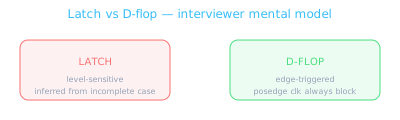
"A latch is transparent when enable is high — synthesis infers it when a combinational output isn't assigned in every branch. I default all outputs at the top of always @(*), or use if/else if/else covering all cases. In sequential logic, every reg gets assigned every clock — that's a flop, not a latch."
FIFO full / empty
Question: "Design a synchronous FIFO with full and empty flags."
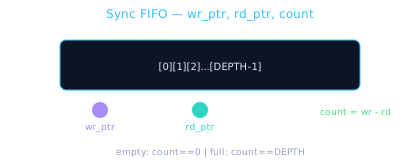
// Pointer + count approach (DEPTH must be power of 2 for ptr wrap)
localparam PTR_W = $clog2(DEPTH);

reg [PTR_W:0] wr_ptr, rd_ptr;  // extra bit for full/empty discrimination
wire [PTR_W:0] count = wr_ptr - rd_ptr;

assign empty = (count == 0);
assign full  = (count == DEPTH);
assign wr_en_ok = wr_en && !full;
assign rd_en_ok = rd_en && !empty;

always @(posedge clk or negedge rst_n) begin
  if (!rst_n) begin
    wr_ptr <= 0;
    rd_ptr <= 0;
  end else begin
    if (wr_en_ok) wr_ptr <= wr_ptr + 1;
    if (rd_en_ok) rd_ptr <= rd_ptr + 1;
  end
end
"Same clock domain — I use write and read pointers plus a count or MSB trick. Empty when pointers equal, full when write has lapped read. I gate wr_en when full and rd_en when empty to prevent corruption. For async FIFO I'd need gray pointers — different question, see our CDC lesson."
Using only lower bits of pointers without the extra MSB — you can't distinguish full from empty when both pointers are equal. See sync FIFO lesson.
CDC — 2-flop synchronizer (why not bus)
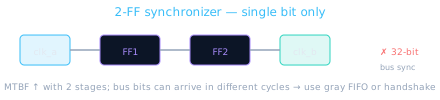
Question: "Cross a single-bit control from clk_a to clk_b. Why not synchronize a 32-bit bus this way?"
module sync_2ff (
  input  wire clk_dst,
  input  wire rst_n,
  input  wire async_in,   // from other clock domain
  output wire sync_out
);
  (* ASYNC_REG = "TRUE" *) reg meta, sync;
  always @(posedge clk_dst or negedge rst_n) begin
    if (!rst_n) begin meta <= 1'b0; sync <= 1'b0; end
    else begin meta <= async_in; sync <= meta; end
  end
  assign sync_out = sync;
endmodule
"For a single control bit I use two flops on the destination clock — first may go metastable, second samples a settled value. Never synchronize a multi-bit bus with independent 2-FF chains — bits can skew across cycles and you'll read garbage. Use gray-code pointers in async FIFO, or a handshake with req/ack. That's exactly the gap I'd fix on sda_i in my I2C capstone."
Deep dive: CDC don'ts — bus vs gray and multi-clock mindset.
FSM safe default
Question: "Write a Moore FSM with safe recovery from illegal states."
typedef enum logic [1:0] { IDLE, LOAD, RUN, DONE } state_t;
state_t state, next;

always @(posedge clk or negedge rst_n) begin
  if (!rst_n) state <= IDLE;
  else        state <= next;
end

always @(*) begin
  next = IDLE;  // safe default — any unhandled state recovers
  case (state)
    IDLE: next = start ? LOAD : IDLE;
    LOAD: next = RUN;
    RUN:  next = done_flag ? DONE : RUN;
    DONE: next = ack ? IDLE : DONE;
    default: next = IDLE;  // synthesis + sim safety net
  endcase
end
"I default next_state to IDLE at the top — if state is corrupted or I add a new state and forget a branch, the FSM recovers instead of latching in an illegal encoding. My I2C byte FSM does the same: ABORT from any state forces IDLE. Two always blocks: one seq for state reg, one combo for next — classic Moore style from our FSM lessons."
See safe FSM design and your I2C byte FSM.
Counter / modulo
Question: "Build a counter that counts 0 to N-1 then wraps."
module modulo_counter #(
  parameter int MAX = 8  // counts 0 .. MAX-1
) (
  input  wire       clk,
  input  wire       rst_n,
  input  wire       en,
  output reg [$clog2(MAX)-1:0] count
);
  localparam int LAST = MAX - 1;

  always @(posedge clk or negedge rst_n) begin
    if (!rst_n)
      count <= 0;
    else if (en) begin
      if (count == LAST)
        count <= 0;
      else
        count <= count + 1;
    end
  end
endmodule
"Compare to LAST, wrap to zero — that's the I2C CLKDIV pattern. Width is $clog2(MAX) bits. If MAX isn't power of two, this compare-wrap is cleaner than modulo operator which some synthesis tools handle poorly. I'd mention the I2C bit engine counts down from CLKDIV to zero — same idea, different direction."
Off-by-one: counting 0..N instead of 0..N-1. Always state inclusive range aloud in the interview.
Priority mux / light arbiter
Question: "Four requesters, one grant — fixed priority."
module priority_arb (
  input  wire [3:0] req,
  output reg  [3:0] gnt
);
  always @(*) begin
    gnt = 4'b0000;
    if (req[0])      gnt = 4'b0001;  // highest priority
    else if (req[1]) gnt = 4'b0010;
    else if (req[2]) gnt = 4'b0100;
    else if (req[3]) gnt = 4'b1000;
  end
endmodule
"Fixed priority is a priority encoder — lowest index wins. One-hot grant, at most one bit set. For fairness I'd use round-robin from our arbiter lesson. Multi-master I2C would need bus arbitration — check SDA high before START — that's the protocol version of this pattern."
Extension: arbiters lesson.
Setup / hold intuition
Question: "Explain setup and hold. What happens if you violate them?"
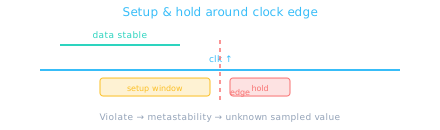
Talk track: "Setup: data must be stable before the clock edge by tsu. Hold: data must stay stable after the edge by th. Violate either and the flop may go metastable — output hovers between 0 and 1, then resolves randomly. That's why we don't sample async pads blindly — my I2C ACK sample happens when SCL is stable high, giving implicit setup."
Course links: clocks setup hold, critical path intuition.
Practice checklist — before your next interview
- Write blocking vs non-blocking fix from memory in <60s
- Draw 2-FF sync and explain why not for 32-bit bus
- Code FIFO empty/full with pointer MSB trick
- Add default case to any FSM on whiteboard
- Explain setup/hold with one hand-wave diagram
- Connect each pattern to I2C capstone or course lab
- Practice Rule → Code → Why → Trap narration for each
Don't start typing code immediately. Pause, restate the question, say "I'll use a two-always-block Moore FSM with safe default" — then write. Interviewers score process.
Bonus pattern — reset synchronizer
Question: "Why sync reset deassert? Show the circuit."
// Async assert (immediate) + sync deassert (avoid reset removal metastability)
module reset_sync (
  input  wire clk,
  input  wire rst_n_async,  // from pad — may be async
  output wire rst_n_sync
);
  (* ASYNC_REG = "TRUE" *) reg r1, r2;
  always @(posedge clk or negedge rst_n_async) begin
    if (!rst_n_async) begin r1 <= 1'b0; r2 <= 1'b0; end  // async assert
    else begin r1 <= 1'b1; r2 <= r1; end                    // sync deassert
  end
  assign rst_n_sync = r2;
endmodule
"Assert async so reset works even if clock is dead. Deassert synchronously — releasing reset near a clock edge can cause metastability in downstream flops. Two-flop chain on deassert is standard ASIC practice." Tie to reset synchronizers lesson.
Pattern difficulty ladder
| Level | Patterns | When asked |
|---|---|---|
| Junior | Blocking/NB, latch fix, counter, FSM default | Phone screen, new grad onsite |
| Junior+ | FIFO flags, 2-FF sync, priority arb, setup/hold | Technical round 1–2 |
| Mid | Gray async FIFO, pipeline hazard, multi-clock handshake | After 2+ yr experience |
After this course you're solid on the Junior column. Junior+ is reachable with deliberate practice — that's your 30-day goal from 12.4.
🎯 What to remember
- Eight patterns cover ~80% of junior RTL whiteboard questions.
- Narrate: Rule → Code → Why → Trap — don't go silent.
- Tie answers to course labs and your I2C capstone where possible.
- Async FIFO / gray code is the follow-up when they say "cross clocks."
- Lesson 12.3 maps these skills to job descriptions.