Reading job JDs — ASIC vs FPGA vs IP design roles
Job descriptions are wish lists, not exams. Your job is to decode must-have vs nice-to-have, spot red flags, and map what you actually built in this course to the bullets recruiters keyword-scan for.
If you match 60% of must-haves and can speak honestly to 2 portfolio artifacts, apply. Don't self-reject on nice-to-haves like "5 years UVM" when you're targeting junior RTL.
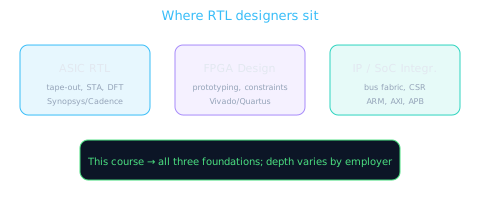
Three RTL role families
| Role type | Typical keywords | What they actually want | Course coverage |
|---|---|---|---|
| ASIC RTL | Verilog, synthesis, timing closure, lint, CDC, low-power | Synthesizable RTL that closes timing at target freq | Modules 1–10, FPGA vs ASIC, lint/CDC lessons |
| FPGA | Vivado, Quartus, constraints, ILA, bring-up, embedded | Get bitstream working on hardware fast | RTL + constraints intro in 11.6 |
| IP design | Reusable block, parameterizable, CSR, documentation | Clean interface, verified IP others integrate | I2C capstone = IP block pattern |
| SoC integration | AXI, APB, interconnect, clock domains | Wire blocks together, debug system issues | CSR map, handshakes, CDC mindset |
Keyword decoder — must-have vs nice-to-have
| JD phrase | Likely tier | Your honest answer after this course |
|---|---|---|
| Verilog / SystemVerilog RTL | Must-have | ✓ Verilog throughout; SVA lite in assertions lesson |
| FSM design | Must-have | ✓ Protocol FSM lab + I2C byte FSM capstone |
| Synthesis / lint clean RTL | Must-have | ✓ coding style, lint |
| Simulation / testbench | Must-have | ✓ Self-checking TB — Module 9 + I2C 11.5 |
| CDC / metastability | Must-have (ASIC) | △ Concepts + 2-FF — CDC lesson; not tape-out depth |
| Timing / STA | Must-have (ASIC) | △ Intuition — setup/hold; not closure tool mastery |
| UVM / OVM | Nice-to-have (junior) | ✗ Not this course — see 12.4 roadmap |
| 5+ years experience | Often flexible | Portfolio + capstone can substitute for juniors |
| Python / Perl scripting | Nice-to-have | TB automation — learn on the job |
| Physical design / PnR | Different team | △ Awareness from PD lesson |
Red flags in job postings
"Full-stack chip engineer" — RTL + PD + verification + analog for one person. Often understaffed team or unrealistic scope.
"Expert in everything" — 15 must-haves including UVM, STA, FPGA, and embedded C. Real role is probably one of those.
No team / product context — Generic copy-paste JD with no chip name, no block description, no tech node hint.
"Unpaid trial project" — Legitimate companies don't ask for weeks of free RTL work upfront.
Salary range missing + "competitive" only — Not always bad, but pair with Glassdoor/levels research before investing interview prep.
Named block (e.g. "DDR controller," "PCIe PHY wrapper"), specific tools, mention of mentorship, clear junior/mid/senior level, realistic tool list matching the role family.
Map THIS course to JD bullets
| Common JD bullet | Course evidence | Artifact to cite |
|---|---|---|
| Design and implement synthesizable RTL | Modules 2–8 labs, I2C capstone | GitHub rtl/ folder |
| Develop finite state machines | protocol FSM lab, I2C byte FSM | FSM diagram in README |
| Create self-checking testbenches | Module 9, 11.5 | Sim PASS log |
| Understand clock domains / CDC | CDC modules | Design review Section 4 |
| Lint-clean coding practices | lint lessons | Lint checklist in review |
| Interface with software via registers | CSR design in I2C | CSR map doc |
| Debug with waveforms | waveform debug | Annotated waveform PNG |
| Participate in design reviews | review culture, 11.6 | One-page review PDF |
Sample JD annotations — 3 fictional postings
Requirements: Verilog RTL for peripheral blocks. FSM and CSR design. Lint-clean code. Simulation with directed tests. Understanding of setup/hold. CDC awareness. Nice: SystemVerilog, UVM exposure.
Requirements: Xilinx Vivado, Verilog, timing constraints, on-chip debug (ILA), board bring-up. 3+ years. AXI interconnect experience required.
Requirements: 10+ years, ownership of high-speed SerDes IP, timing closure to 2 GHz, UVM regression ownership, customer support.
Resume bullet templates — honest versions
Replace bracketed text. Every bullet must survive "tell me more" in an interview.
## I2C Capstone (Module 11)
• Designed synthesizable I2C master (CSR + byte FSM + bit engine) with
  open-drain pad modeling; verified via self-checking TB (write/ACK/NACK/abort)

• Authored one-page design review covering lint, CDC sampling strategy, and
  timing budget (CLKDIV → I2C rate); documented v2 extensions (clock stretch, read)

## Course Labs (pick 2–3)
• Built parameterized sync FIFO with full/empty flags; lint-clean pointer logic
  (Module 8 — map to JD "FIFO" keyword)

• Implemented Moore FSM for [protocol] with safe default recovery; passed
  directed corner-case tests (Module 5 FSM lab)

• Applied 2-FF synchronizer for single-bit CDC; documented why multi-bit bus
  requires gray/handshake (Module 10 CDC)

## Skills line (honest)
Verilog RTL · FSM design · CSR/register interfaces · self-checking simulation ·
lint-aware coding · CDC/timing intuition · waveform debug
Don't write "expert in UVM/STA" from this course alone. Write "timing intuition" and "directed verification" — then deepen in 12.4 roadmap.
Application workflow checklist
- Highlight must-have keywords in yellow — map each to a course module
- Ignore nice-to-haves unless you have real evidence
- Tailor top 3 resume bullets to match JD A/B/C family (ASIC/FPGA/IP)
- Link GitHub repo with README that runs in 5 minutes
- Prepare 2-min I2C pitch from 12.1
- Prepare one whiteboard pattern from 12.2
- Research company product — one sentence "why this chip" in cover note
Salary and level calibration
| Level signal in JD | Typical expectation | Your positioning |
|---|---|---|
| Intern / new grad | 0–1 yr, mentorship, coursework OK | Lead with capstone + course labs |
| Junior / associate | 0–2 yr, block ownership with review | I2C + 2 lab artifacts + honest gaps |
| Mid-level | 3–5 yr, independent tape-out blocks | Need industry experience — course alone insufficient |
| Senior / staff | 5+ yr, architecture + mentoring | Skip unless internal transfer |
Geography matters: FPGA roles cluster in defense/aerospace hubs; ASIC RTL in Bay Area, Austin, Bangalore, Israel. Remote RTL roles exist but often require prior industry experience.
Cover letter — 3-sentence template
I'm applying for the Junior RTL Engineer role. I recently completed
an intensive RTL Design course culminating in a synthesizable I2C
master — CSR map, byte FSM, open-drain bit engine, and self-checking
testbench (write/ACK/NACK/abort), with a one-page design review
documenting lint, CDC, and timing decisions.

Your JD emphasizes FSM design and lint-clean Verilog — I built both
in my capstone and can walk through architecture and waveforms in
a technical interview. Repo: [github link].

I'm eager to contribute to [specific product/block from company
research] and grow into timing closure and broader SoC integration.
Tool keywords — what they mean
| Tool / term | Role family | Your status |
|---|---|---|
| Design Compiler / Genus | ASIC synthesis | Concept from synthesis lesson |
| PrimeTime / Tempus | STA signoff | Intuition only — 12.4 roadmap |
| SpyGlass / HAL | RTL lint | Manual lint checklist in 11.6 |
| VCS / Xcelium / Questa | Simulation | Course simulator experience |
| Vivado / Quartus | FPGA | Learn on job or side project |
| Verdi / SimVision | Waveform debug | ✓ waveform method |
| UVM | DV regression | Not this course — see 12.4 |
If asked "have you used Design Compiler?" — say "I understand synthesis from RTL to gates conceptually; I haven't run DC in production but I'm ready to learn your flow on the job."
Verification vs RTL — don't confuse the JD
| JD title | Primary work | This course fit |
|---|---|---|
| Design Verification Engineer | Write TB, coverage, assertions — often UVM | Partial — TB skills yes, UVM no |
| RTL Design Engineer | Write synthesizable logic | Strong — core course focus |
| FPGA Engineer | RTL + tools + hardware | RTL strong, tools you learn on job |
| Physical Design Engineer | Floorplan, place, route | Not this course — awareness only |
If the JD says "verification" in the title but lists UVM as must-have, that's a DV role — your I2C TB is relevant, but lead with "directed self-checking" not "designed the RTL" unless the bullet fits.
Networking & referrals — practical steps
- Connect with 5 RTL engineers on LinkedIn — comment thoughtfully on their posts
- Join one VLSI/FPGA Discord or Slack — ask one specific question per week
- Attend one virtual meetup — prepare 30-sec intro + GitHub link
- Ask course peers for mock interviews — reciprocate
- Alumni from your university in semiconductor — informational 15-min chats
Referred candidates get interviews at 5–10× the rate of cold applications. Your capstone repo is the conversation starter: "I built this I2C block — would love your feedback on the architecture."
| Outreach message | Do | Don't |
|---|---|---|
| Length | 3–4 sentences + link | Wall of text about your whole career |
| Ask | "15-min chat about junior RTL path" | "Can you get me a job?" |
| Proof | GitHub capstone link | Attach 20MB zip of all course labs |
Quick JD triage — 5-minute decision
- Read title — RTL, DV, FPGA, or PD?
- Highlight must-haves (usually first 5 bullets)
- Count matches from course map (Section 4) — need ≥3
- Check for red flags (Section 3)
- If pass: tailor resume + apply within 48 hours
Spending 2 hours researching a junior role you'll never apply to is procrastination. Triage in 5 minutes, apply or skip, move on. Volume + quality portfolio beats perfect JD analysis.
🎯 What to remember
- Three families: ASIC RTL, FPGA, IP/SoC integration — same foundations, different emphasis.
- Apply when you match ~60% of must-haves; ignore most nice-to-haves.
- Map every JD keyword to a course module + artifact.
- Use honest resume bullets — I2C capstone is your strongest line.
- Lesson 12.4 covers what to learn next (STA, UVM, PD).