What to learn next — STA, UVM, PD (honest roadmap)
You finished the RTL Design course. That puts you ahead of most bootcamp graduates — but it does not make you a 10-year senior. This lesson is an honest map of what comes next, what you can claim today, and a 30/60/90-day practice plan.
🎉 Course complete — you earned this
Modules 0–11 + Career Layer 12. You have synthesizable RTL skills, a portfolio capstone, and interview ammunition. The learning doesn't stop — it compounds.
Module 0–11 recap — what you built
| Module | Core skill | Key artifact |
|---|---|---|
| 0–1 | Verilog syntax, sim workflow | Simulator fluency |
| 2 | Combinational RTL, latches | ALU / mux labs |
| 3 | Flops, counters, FSM styles | Safe FSM |
| 4 | Datapath + control split | Mini project |
| 5 | Protocol sequencing | Protocol FSM lab |
| 6 | Pipelines, stalls, forwarding | Pipelined ALU |
| 7 | Regfiles, sync FIFO | FIFO lab |
| 8 | Arbiters, skid buffers | Arbiter patterns |
| 9 | Self-checking TB, corners | TB methodology |
| 10 | CDC, lint, timing intuition | 2-FF sync |
| 11 | End-to-end IP block | I2C + review pack |
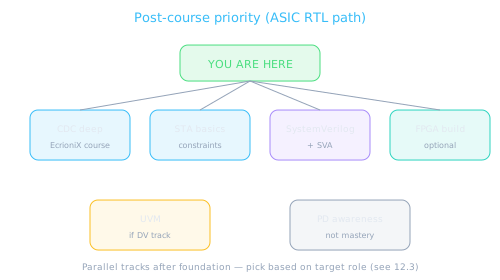
Learning roadmap — priority order
STA / timing closure — next steps
This course gave you setup/hold intuition and critical path thinking. STA tool mastery is the next layer.
| Topic | What you know | What to learn next |
|---|---|---|
| Setup / hold | Conceptual — flop sampling windows | Read PrimeTime / Tempus reports; slack, WNS, TNS |
| Clock constraints | Example SDC in 11.6 | Write create_clock, set_input_delay for your block |
| False / multicycle paths | Mentioned for reset, slow I2C | Justify each exception in review doc |
| Timing closure loop | QoR loop intro | Run synthesis → STA → fix RTL or constraints → repeat |
- Run open-source Yosys + OpenSTA on a small counter — see slack numbers
- Read one PrimeTime report (ask on forums / university lab)
- Document critical path for I2C bit engine in review appendix
- Learn
set_false_pathvsset_multicycle_path— when each applies
You cannot claim "timing closure experience" from this course alone. Claim "timing intuition and constraint awareness" — then back it up with one synthesis run.
UVM / verification career path
UVM is the industry standard for ASIC verification — but it's a different job from RTL design for many teams.
RTL designer
Directed TB + assertions often enough at junior level. Your I2C self-checking TB is credible.
DV engineer
UVM required at most ASIC houses. Learn after solid Verilog — 2–3 month investment.
FPGA engineer
Often directed TB + ILA. UVM less common unless ASIC prototyping flow.
| Stage | Skill | Resource path |
|---|---|---|
| Now | Directed self-checking TB | Module 9, I2C 11.5 — done |
| Next | SystemVerilog + SVA | SVA lite lesson → full SV book |
| Then | UVM basics — agent, driver, monitor | Verification Academy, EDAPlayground |
| Later | Coverage-driven verification | Coverage basics → UVM reg model |
Targeting junior RTL or FPGA roles? Deepen RTL + STA + CDC first. Add UVM only if JDs you want list it as must-have — see 12.3.
Physical design — awareness, not mastery
RTL designers don't place and route — but they need to speak PD's language.
- Floorplan impact: Pad-adjacent blocks (like I2C) vs core logic — affects wire delay
- Clock tree: Your
sys_clkbecomes a distributed tree — skew matters for hold - Power: Clock gating decisions start in RTL
- DFT: Scan chains affect how you write reset and pad logic
Read physical design lesson and signoff overview — enough to not embarrass yourself in a cross-team meeting. Don't try to become a PD engineer unless that's the role you want.
SystemVerilog / SVA — deepen
Industry RTL increasingly uses SystemVerilog. Your Verilog transfers — add these incrementally:
// Assert START condition: SDA falls while SCL is high
property p_i2c_start;
  @(posedge clk) disable iff (!rst_n)
    (scl === 1'b1) |-> ##[0:2] (sda === 1'b0);
endproperty
ap_start: assert property (p_i2c_start);
- Learn
logicvswire/reg— mostly dropregin SV - Interfaces for bus connections (APB, AXI later)
- Assertions on FSM illegal states and protocol rules
- typedef enum for state — you already saw this in 12.2
CDC — EcrioniX deep dive
Module 10 introduced CDC mindset. For ASIC roles, take the dedicated EcrioniX CDC course when available — it covers:
- Gray-code async FIFO (full implementation)
- Handshake protocols (req/ack)
- CDC lint tools (SpyGlass, Jasper)
- Real waiver documentation
- MTBF calculation intuition
Bridge from I2C: Your documented sda_i gap becomes a CDC course lab — implement 2-FF sync, re-run TB, update review doc. That's a portfolio upgrade story.
Start with: CDC don'ts, async FIFO overview, multi-clock mindset.
30 / 60 / 90-day practice plan
| Window | Focus | Deliverable |
|---|---|---|
| Days 1–30 | Portfolio polish + interview prep | GitHub repo live, 2-min pitch rehearsed, apply to 10 JDs |
| Re-run I2C capstone + annotate waves | README + waveform PNG + design review PDF | |
| Whiteboard drills from 12.2 | 8 patterns from memory | |
| Days 31–60 | I2C v1.1 — clock stretching | Updated RTL + TB + review doc v2 |
| STA intro — one synthesis run | Screenshot of slack report in repo | |
| SystemVerilog — rewrite one module | i2c_byte_fsm.sv with typedef enum | |
| Days 61–90 | CDC upgrade — sda_i 2-FF sync | CDC section in review → "fixed" |
| Second portfolio block OR FPGA bitstream | UART, SPI, or I2C on dev board | |
| Mock interviews (peer or mentor) | Record + fix weak answers |
Course completion checkpoint — claim honestly
"I completed a structured RTL Design course with synthesizable Verilog labs, CDC/timing fundamentals, self-checking verification, and an I2C master capstone with design review documentation."
| Claim | Honest? | Evidence |
|---|---|---|
| Synthesizable Verilog RTL | ✓ Yes | I2C + course labs |
| FSM design & protocol sequencing | ✓ Yes | Byte FSM + protocol lab |
| Self-checking simulation | ✓ Yes | TB PASS log |
| Lint-aware coding | ✓ Yes | Review lint section |
| CDC / timing intuition | ✓ Yes (intro) | 2-FF, setup/hold, review doc |
| Design review participation | ✓ Yes | One-page review template filled |
| UVM expertise | ✗ No | Not in this course |
| Timing closure to tape-out | ✗ No | Intuition only — STA is next |
| 5 years industry experience | ✗ No | Portfolio substitutes for junior roles |
Don't list "UVM, STA, PD" as skills unless you've done real work. List "Verilog RTL, FSM, CSR design, directed verification, lint-aware coding" — then add skills as you earn them.
Recommended reading & practice resources
| Topic | Resource | Why |
|---|---|---|
| Verilog → SV | SystemVerilog for Verification (Spear) | Industry-standard SV syntax |
| FSM / design | RTL Modeling with SystemVerilog (Sutherland) | Production coding style |
| CDC | EcrioniX CDC course (when live) | Closes Module 10 gap |
| STA | PrimeTime user guide + online tutorials | Hands-on slack reading |
| Interview prep | Reuse 12.2 patterns daily | Muscle memory |
| Community | Verilog subreddit, EDA board, local VLSI meetups | Job leads + mock interviews |
Read 30 min/day
One STA chapter or SV section. Consistency beats weekend cramming.
Code 1 hr/day
Extend I2C or rewrite one lab in SystemVerilog. Ship small commits.
Rehearse 15 min/day
2-min pitch out loud. Record yourself — fix filler words.
FPGA vs ASIC — pick your next project
| Path | Next project | Skills gained |
|---|---|---|
| ASIC RTL | I2C v1.1 + v1.2 (stretch + read) | Protocol depth, regression discipline |
| FPGA | Bitstream I2C on dev board (PMOD) | Constraints, ILA, real pads |
| DV | Rewrite I2C TB in SystemVerilog + SVA | Assertions, structured TB |
| SoC integr. | Wrap I2C in APB slave stub | Bus protocol, address decode |
Skills inventory — copy to LinkedIn
Verilog RTL · Finite State Machines · CSR/Register Design ·
Self-Checking Testbenches · Directed Verification · Lint-Aware Coding ·
Combinational & Sequential Logic · Synchronous FIFO Design ·
CDC Awareness (2-FF synchronizer) · Setup/Hold Timing Intuition ·
Waveform Debug · Design Review Documentation · Open-Drain Pad Modeling ·
I2C Protocol · Git / Version Control

Learning next: SystemVerilog · STA/SDC constraints · Clock stretching RTL
Module 12 recap — career layer complete
- 12.1 — Present I2C project: 2-min pitch, portfolio, scorecard
- 12.2 — RTL interview patterns: 8 worked solutions + narration
- 12.3 — Reading job JDs: ASIC/FPGA/IP decode + resume bullets
- 12.4 — This lesson: roadmap, practice plan, honest claims
Learners finish courses. Hires ship artifacts, rehearse interviews, apply consistently, and upgrade their capstone based on feedback. You have the course — now run the 90-day plan.
🏆 You finished RTL Design
From "what is a flop?" to defending an I2C capstone in an interview. Go build something on silicon — or at least on an FPGA. The industry needs engineers who ship.
🎯 What to remember
- Modules 0–11 gave you RTL foundations + I2C portfolio — that's real.
- Next priorities: CDC deep dive, STA basics, SystemVerilog — UVM only if DV track.
- PD awareness is enough; timing closure and UVM come with deliberate practice.
- 30/60/90-day plan turns completion into career momentum.
- Claim honestly — credibility beats keyword stuffing every time.